Alan’s blog

November 9, 2011

After the Tech Wave is over

Filed under: academic,HCI and usability — alan @ 10:54 pm

The Second Tiree Tech Wave is over.   Yesterday the last participants left by ferry and plane and after a final few hours tidying, the Rural Centre, which the day before had been a tangle of wire and felt, books and papers, cups and biscuit packets, is now as it had been before.  And as I left, the last boxes under my arm, it was strangely silent with only the memory of voices and laughter in my mind.

So is it as if it had never been?  I there anything left behind?  There are a few sheets of Magic Whiteboard on the walls, that I left so that those visiting the Rural Centre in the coming weeks can see something of what we were doing, and there are used teabags and fish-and-chip boxes in the bin, but few traces.

We trod lightly, like the agriculture of the island, where Corncrake and orchid live alongside sheep and cattle.

Some may have heard me talk about the way design is like a Spaghetti Western. In the beginning of the film Clint Eastwood walks into the town, and at the end walks away.  He does not stay, happily ever after, with a girl on his arm, but leaves almost as if nothing had ever happened.

But while he, like the designer, ultimately leaves, things are not the same.  The Carson brothers who had the town in fear for years lie dead in their ranch at the edge of town, the sharp tang of gunfire still in the air and the buzz of flies slowly growing over the elsewise silent bodies.  The crooked major, who had been in the pocket of the Carson brothers, is strapped over a mule heading across the desert towards Mexico, and not a few wooden rails and water buts need to be repaired.  The job of the designer is not to stay, but to leave, but leave change: intervention more than invention.

But the deepest changes are not those visible in the bullet-pocked saloon door, but in the people.  The drunk who used to sit all day at the bar, has discovered that he is not just a drunk, but he is a man, and the barmaid, who used to stand behind the bar has discovered that she is not just a barmaid, but she is a woman.

This is true of the artefacts we create and leave behind as designers, but much more so of the events, which come and go through our lives.  It is not so much the material traces they leave in the environment, but the changes in ourselves.

I know that, as the plane and ferry left with those last participants, a little of myself left with them, and I know many, probably all, felt a little of themselves left behind on Tiree.  This is partly abut the island itself; indeed I know one participant was already planning a family holiday here and another was looking at Tiree houses for sale on RightMove!  But it was also the intensity of five, sometimes relaxed, sometimes frenetic, days together.

So what did we do?

There was no programme of twenty minute talks, no keynotes or demo, indeed no plan nor schedule at all, unusual in our diary-obsessed, deadline-driven world.

Well, we talked.  Not at a podium with microphone and Powerpoint slides, but while sitting around tables, while walking on the beach, and while standing looking up at Tilly, the community wind turbine, the deep sound of her swinging blades resonating in our bones.  And we continued to talk as the sun fell and the overwhelmingly many stars came out , we talked while eating, while drinking and while playing (not so expertly) darts.

We met people from the island those who came to the open evening on Saturday, or popped in during the days, and some at the Harvest Service on Sunday.  We met Mark who told us about the future plans for Tiree Broadband, Jane at PaperWorks who made everything happen, Fiona and others at the Lodge who provided our meals, and many more. Indeed, many thanks to all those on the island who in various ways helped or made those at TTW feel welcome.

We also wrote.  We wrote on sheets of paper, notes and diagrams, and filled in TAPT forms for Clare who was attempting unpack our experiences of peace and calmness in the hope of designing computer systems that aid rather than assault our solitude.  Three large Magic Whiteboard sheets were entitled “I make because …”, “I make with …”, “I make …” and were filled with comments.  And, in these days of measurable objectives, I know that at least a grant proposal, book chapter and paper were written during the long weekend; and the comments on the whiteboards and experiences of the event will be used to create a methodological reflection of the role of making in research which we’ll put into Interfaces and the TTW web site.

We moved.  Walking, throwing darts, washing dishes, and I think all heavily gesturing with our hands while taking.  And became more aware of those movements during Layda’s warm-up improvisation exercises when we mirrored one another’s movements, before using our bodies in RePlay to investigate issues of creativity and act out the internal architecture of Magnus’ planned digital literature system.

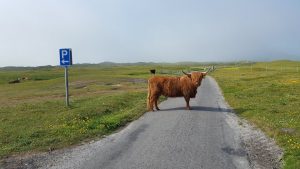
We directly encountered the chill of wind and warmth of sunshine, the cattle and sheep, often on the roads as well as in the fields.  We saw on maps the pattern of settlement on the island and on display boards the wools from different breeds on the island. Some of us went to the local historical centre, An Iodhlann [[ http://www.aniodhlann.org.uk/ ]], to see artefacts, documents and displays of the island in times past, from breadbasket of the west of Scotland to wartime airbase.

We slept.  I in my own bed, some in the Lodge, some in the B&B round the corner, Matjaz and Klem in a camper van and Magnus – brave heart – in a tent amongst the sand dunes.  Occasionally some took a break and dozed in the chairs at the Rural Centre or even nodded off over a good dinner (was that me?).

We showed things we had brought with us, including Magnus’ tangle of wires and circuit boards that almost worked, myself a small pack of FireFly units (enough to play with I hope in a future Tech Wave), Layda’s various pieces she had made in previous tech-arts workshops, Steve’s musical instrument combining Android phone and cardboard foil tube, and Alessio’s impressively modified table lamp.

And we made.  We do after all describe this as a making event!  Helen and Claire explored the limits of ZigBee wireless signals.  Several people contributed to an audio experience using proximity sensors and Arduino boards, and Steve’s CogWork Chip: Lego and electronics, maybe the world’s first mechanical random-signal generator.  Descriptions of many of these and other aspects of the event will appear in due course on the TTW site and participants’ blogs.


But it was a remark that Graham made as he was waiting in the ferry queue that is most telling.  It was not the doing that was central, the making, even the talking, but the fact that he didn’t have to do anything at all.  It was the lack of a plan that made space to fill with doing, or not to do so.

Is that the heart?  We need time and space for non-doing, or maybe even un-doing, unwinding tangles of self as well as wire.

There will be another Tiree Tech Wave in March/April, do come to share in some more not doing then.

Who was there:

  • Alessio Malizia – across the seas from Madrid, blurring the boundaries between information, light and space
  • Helen  Pritchard – artist, student of innovation and interested in cows
  • Claire  Andrews – roller girl and researching the design of assistive products
  • Clare  Hooper – investigating creativity, innovation and a sprinkling of SemWeb
  • Magnus  Lawrie – artist, tent-dweller and researcher of digital humanities
  • Steve Gill – designer, daredevil and (when he can get me to make time) co-authoring book on physicality TouchIT
  • Graham Dean – ex-computer science lecturer, ex-businessman, and current student and auto-ethnographer of maker-culture
  • Steve Foreshaw - builder, artist, magician and explorer of alien artefacts
  • Matjaz Kljun – researcher of personal information and olive oil maker
  • Layda Gongora – artist, curator, studying improvisation, meditation and wild hair
  • Alan Dix – me

March 6, 2011

the real tragedy of the commons

Filed under: academic,personal,political,web development — alan @ 7:07 pm

I’ve just been reviewing a paper that mentions the “tragedy of the commons”1  and whenever I read or hear the phrase I feel the hackles on the back of my neck rise.

Of course the real tragedy of the commons was not free-riding and depletion by common use, but the rape of the land under mass eviction or enclosure movements when they ceased to be commons.  The real tragedy of “the tragedy of the commons” as a catch phrase is that it is often used to promote the very same practices of centralisation.  Where common land has survived today, just as in the time before enclosures and clearances, it is still managed in a collaborative way both for the people now and the for the sake of future generations.  Indeed on Tiree, where I live, there are large tracts of common grazing land managed in just such a way.

It is good to see that the Wikipedia article of “Tragedy of the Commons” does give a rounded view on the topic including reference to an historical and political critique by “Ian Angus”2

The paper I was reading was not alone in uncritically using the phrase.  Indeed in “A Framework for Web Science”3 we read:

In a decentralised and growing Web, where there are no “owners” as such, can we be sure that decisions that make sense for an individual do not damage the interests of users as a whole? Such a situation, known as the ‘tragedy of the commons’, happens in many social systems that eschew property rights and centralised institutions once the number of users becomes too large to coordinate using peer pressure and moral principles.

In fact I do have some sympathy with this as the web involves a vast number of physically dispersed users who are perhaps “too large to coordinate using peer pressure and moral principles”.  However, what is strange is that the web has raised so many modern counter examples to the tragedy of the commons, not least Wikipedia itself.  In many open source projects people work as effectively a form of gift economy, where, if there is any reward, it is in the form of community or individual respect.

Clearly, there are examples in the world today where many individual decisions (often for short term gain) lead to larger scale collective loss.  This is most clearly evident in the environment, but also the recent banking crisis, which was fuelled by the desire for large mortgages and general debt-led lives.  However, these are exactly the opposite of the values surrounding traditional common goods.

It may be that the problem is not so much that large numbers of people dilute social and moral pressure, but that the impact of our actions becomes too diffuse to be able to appreciate when we make our individual life choices.  The counter-culture of many parts of the web may reflect, in part, the way in which aspects of the web can make the impact of small individual actions more clear to the individual and more accountable to others.


  1. Garrett Hardin, “The Tragedy of the Commons”, Science, Vol. 162, No. 3859 (December 13, 1968), pp. 1243-1248. … and here is the danger of citation counting as a quality metric, I am citing it because I disagree with it! [back]
  2. Ian Angus. The Myth of the Tragedy of the Commons. Socialist Voice, August 24, 2008 [back]
  3. Berners-Lee, T., Hall, W., Hendler, J. A., O’Hara, K., Shadbolt, N. and Weitzner, D. J. (2006) A Framework for Web Science. Foundations and Trends in Web Science, 1 (1). pp. 1-130.  http://eprints.ecs.soton.ac.uk/13347/ [back]

January 22, 2011

announcing Tiree Tech Wave!

Filed under: academic,HCI and usability,web development — alan @ 8:56 pm

Ever since I came to Tiree I’ve had a vision of bringing people here, to share some of the atmosphere and work together.  A few of you have come on research visits and we have had some really productive times.  Others have said they wished they could come sometime.

Well now is your chance …

Come to Tiree Tech Wave in March to make, talk and play at the wind-ripping edge of digital technology.

seascape

Every year Tiree hosts the Wave Classic, a key international wind surfing event.  Those of us at the edge of the digital wave do not risk cold seas and bodily injury, but there is something of the same thrill as we explore the limits of code, circuit boards and social computation.

iconsThe cutting edge of wind-surfing boards is now high technology, but typically made by artisan craftsfolk, themselves often surfers.  Similarly hardware platforms such as Arduino, mobile apps for iPhone and Android, and web mashups enabled by public APIs and linked data are all enabling a new maker culture, challenging the hegemony of global corporations.

artworkThe Western Celtic fringes were one of the oases of knowledge and learning during the ‘dark ages’.  There is something about the empty horizon that helped the hermit to focus on God and inspired a flowering of decorative book-making, even in the face of battering storms of winter and Viking attacks of summer; a starkness that gave scholars time to think in peace between danger-fraught travel to other centres of learning across Europe.

Nowadays regular Flybe flights and Calmac ferries reduce the risk of Viking attacks whilst travelling to the isles, broadband Internet and satellite TV invade the hermit cell, and double glazing and central heating mollify the elements.  Yet there is still a rawness that helps focus the mind, a slightly more tenuous connection to the global infrastructure that fosters a spirit of self-reliance and independence.

LEDsOver a long weekend 17 – 21 March (TBC), we plan what I hope will be a semi-regular event.  A time to step out, albeit momentarily, from a target-driven world, to experiment and play with hardware and software, to discuss the issues of our new digital maker culture, what we know and what we seek to understand, and above all to make things together.

This is all about technology and people: the physical device that sits in our hands, the data.gov.uk mashup that tells us about local crime, the new challenges to personal privacy and society and the nation state.

Bring your soldering iron, and Arduino boards, your laptop and API specs, your half-written theses and semi-formed ideas, your favourite book or even well-loved eReader (!).  The format will be informal, with lots of time to work hands-on together; however, there will be the opportunity for short talks/demos/how-to-do-it sessions.  Also, if there is demand, I’d  be happy to do some more semi-formal tutorial sessions and maybe others would too (Arduino making, linked data).

Currently we have no idea whether there will be three or three hundred people interested, but aiming for something like 15 – 30 participants.  We’ll keep costs down, probably around £70 for meeting rooms, lunches, etc. over the five days, but will confirm that and more details shortly.

Follow on Twitter at @tireetechwave and the website will be at tireetechwave.com. However, it is still ‘under development’, so don’t be surprised at the odd glich over the next couple of weeks as we sort out details.

If you are interested in coming or want to know more mail me or Graham Dean

November 16, 2010

Back to Tiree – and being ‘half-time’

Filed under: academic,personal — alan @ 7:15 am

I’m on the ferry on the way back to Tiree. It’s been 2 months since I was home and then only one long weekend since the end of August, so it seems both familiar and strange sitting on the Calmac ferry again as it makes its way out of Oban.

Last autumn I had a similar long stay away, then mostly in the camper van near the University as I was still working full time at Lancaster. This year I am working half time at Lancaster, but also half-time for Talis and for the first three months at Talis spending half my time on site at the Talis offices in Birmingham. After that I’ll be doing my Talis job based from home, only going down more occasionally, so after Christmas will get more time at home.

Instead of my camper van I’ve been staying a lot at the ‘Talis house’, a house near Solihull for small off-site meetings and for those like me who live a long way away from Talis’ Birmingham offices (others live in France, Italy, and the USA). It was rather claustrophobic last autumn spending most of my weekends in my office at Lancaster, so having Talis house as a base has been good. However, I do miss that snug feeling in the back of the camper van hunkering under the bedclothes, with a take-away on my knees and watching a DVD, while the van rocked in time to the whistling wind outside.

Working half time for Talis has also imposed a discipline on my time working in my University role. Since last Christmas I have been formally working half time at Lancaster (certainly getting half pay!), but as those who work in the universities know, it is hard to put a limit on things. The idea was that this meant I would get half my time to do ‘my stuff’, research and writing. Of course I knew cutting my old 80-hour weeks down to 20 or even 40 would not happen, but I would at least get a little more time than I have become used to.

One of the half expected and half surprising things about the shift to half-time working for the University last January was the way other people dealt with it.

I guess for years I have implicitly ‘educated’ both fellow academics and students in their expectations; whenever there was something to be done, a report to read or write, I would say things like “ah this weekend I’ve already got this other task to do, but I’ll do it the next weekend” — basically assuming that weekends and evenings, strictly the unpaid times, were the times when things happened. After a bit students would get used to giving me things on Friday in the expectation that I would then have time to do it.

When I shifted to half time people would extend this notion and say “ah now you have more time you can do X”: reviews, reading student work, etc. As I said this was half expected, I had the feeling I would need to re-educate people. However, what surprised me was not that people acted this way, but that they said it, and even wrote it in emails. I would have thought that when they saw it explicitly in front of them they would think, “oh no Alan now has less time for these things”, but no; it is amazing how little we notice of what we say and do.

Anyway now things are different. Instead of it being ‘my time’ that my academic life intruded into, it is now Talis’ time and this is something others can respect more, and I guess I also respect more than my own time.

So how is it working — really being a half-time academic?

In fact of course, I still work most weekends and long days, so I have somewhat more than a full-time week of effort, so I am not yet down to 20 hours of university work, but certainly a lot less time then when I was simply trying to protect my own (unpaid!) time.

In January when I shifted to half-time, I said I’d do a day a week while at home effectively eating nearly half of my ‘half time’, meaning I was expecting to spend about 60 days a year away from home whether on site in Lancaster or travelling. In fact during this Autumn alone, by Christmas I will have spent 53 days either on site in Lancaster or travelling on University business, that is more than 2/3 of the formal 75 working days in the period and nearly all my annual ‘not at home’ Lancs working days! This doesn’t seem to add up given 1/2 time spent in B’ham, but of course the 53 days of Lancaster time includes many weekends away while travelling that I wasn’t used to counting when a ‘full time’ academic.

I clearly need to cut this down further! However, even now, being stricter than I was with ‘my time’, cracks are beginning to show. I can see students getting unhappy as it takes me longer to find time to read things they have written, and colleagues patiently realising that email to me is getting even less reliable. So much of the life of an academic depends on things done in ‘extra time’ whether weekends or evenings, or in my case earlier in the year unpaid time; when you cut back on that things simply do not happen.

From Christmas I will not have the imposed discipline of days at the offices at Talis, so will need to maintain this more for myself. However, the last few months have helped and I will certainly keep careful records to make sure Talis gets its fair share of my time and that the University does not consume so much of my ‘own’ time as rest is also part of working well.

Even though I have effectively ‘used up’ most of my university on-site/travelling days, I will of course not say “no more until next September’ (!), but will at least try to control it more. And I will also try to let some of the more balanced view of work and life I am learning at Talis influence my attitudes at the University.

And no, I won’t be reading email this evening.

August 27, 2010

Roads of the Sea — Tiree to Larne

Filed under: journal,personal — alan @ 11:00 pm

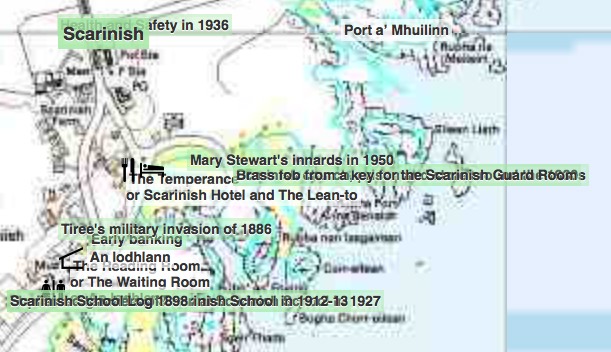
Friday morning at 9am saw me at the ferry queue in Scarinish waiting for the Tiree–Oban ferry, saying goodbye to Fiona and to Tiree as I won’t be home again for most of the next two months.  Friday is an early ferry — 5am check-in for those coming from Oban, but a more civilised time for going to the mainland and a 1pm arrival gives plenty of time to get down to Troon for the 8:20pm ferry.

I’ve never taken the Troon–Larne ferry before, always travelling to Ireland from Stranraer in the North or Holyhead in the South.  However, arriving with a full three hours to spare, I found it is a good place to wait, eating a late picnic lunch of pork pie and salad overlooking the bay with windsurfers and kite surfers along the strand, home from home.

Long distance ‘commutes’ and remote relationships have become common amongst professional workers.  I recall Richard Bentley at one stage working in Germany while his partner was in Jersey, and in the States several West-Coast East-Coast marriages.  However, this is not a recent phenomena, on Tiree there are families of trawler men or those working on the North Sea rigs, where ‘going to work’ means many weeks or months away.  The ‘Express’  Troon–Larne ferry fairly sped along compared with Calmac’s more leisurely vessels, and as I sat and watched us pass Ailsa Craig, struck up conversation with a man on his way home to his wife and family after three months away doing forestry work in Scotland.

Larne, like Crewe, is a place you pass through and rarely stop, but given the late ferry I ended up spending a night there in a small seafront guesthouse, Beach Vista.  The late arrival of the ferry was compounded by a wrong turning1, but despite the late hour Bob the proprietor was waiting with a warm welcome in a rich Northern accent. My childhood images of Northern Ireland are all from news stories of ‘The Troubles’; amidst these images of sectarian violence and bomb blasts, it is easy to forget the warmth of the people and the beauty of the countryside. So I spent a first peaceful night, hearing the sound of the waves lapping against the sea wall.

Walking along the seashore before breakfast, watching a freight ship glide quietly into port past the James Chaine memorial tower, I understood some of Bob’s love of the place.  “Sometimes when my wife and I go away on holiday”, he told me, “we sometimes just wonder why, when we have this at home”.  Despite being less than an hour from Belfast, the pace of life is clearly somewhat slower in Larne.  Bob, as well as running the B&B with his family, also has a Taxi firm, and explained that, just like on Tiree, he doesn’t worry about locking the taxi and even leaving the keys inside.

next Into the West — Larne to Westport


  1. why can’t Google maps include a scale on the printed maps! [back]

August 25, 2010

endings and beginnings: cycling, HR and Talis

Filed under: academic,personal — alan @ 8:26 am

It is the end of the summer, the September rush starts (actually at the end of August) and on Friday I’ll be setting off on the ferry and be away from home for all of September and October :-(   Of course I didn’t manage to accomplish as much as I wanted over the summer, and didn’t get away on holiday … except of course living next to the sea is sort of like holiday every day!  However, I did take some time off when Miriam visited, joining her on cycle rides to start her training for her Kenyan challenge — neither of us had been on a bike for 10 years!  Also this last weekend saw the world come to Tiree when a group of asylum seekers and refugees from the St Augustine Centre in Halifax visited the Baptist Church here — kite making, songs from Zimbabwe and loads of smiling faces.

In September I also hand over departmental personnel duty (good luck Keith :-) ).  I’d taken on the HR role before my switch to part-time at the University, and so most of it stayed with me through the year :-( (Note, if you ever switch to part-time, better to do so before duties are arranged!). Not sorry to see it go, the people bit is fine, but so much paper filling!

… and beginnings … in September (next week!) I also start to work part-time with Talis.  Talis is a remarkable story.  A library information systems company that re-invented itself as a Semantic Web company and now, amongst other things, powering the Linked Data at data.gov.uk.

I’ve known Talis as a company from its pre-SemWeb days when aQtive did some development for them as part of our bid to survive the post-dot.com crash.   aQtive did in the end die, but Talis had stronger foundations and has thrived1.  In the years afterwards two ex-aQtive folk, Justin and Nad, went to Talis and for the past couple of years I have also been on the external advisory group for their SemWeb Platform.  So I will be joining old friends as well as being part of an exciting enterprise.


  1. Libraries literally need very strong foundations.  I heard of one university library that had to be left half empty because the architect had forgotten to take account of the weight of books.  As the shelves filled the whole building began to sink into the ground. [back]

August 8, 2010

Names, URIs and why the web discards 50 years of computing experience

Filed under: academic,HCI and usability,web development — alan @ 5:46 pm

Names and naming have always been a big issue both in computer science and philosophy, and a topic I have posted on before (see “names – a file by any other name“).

In computer science, and in particular programming languages, a whole vocabulary has arisen to talk about names: scope, binding, referential transparency. As in philosophy, it is typically the association between a name and its ‘meaning’ that is of interest. Names and words, whether in programming languages or day-to-day language, are, what philosophers call, ‘intentional‘: they refer to something else. In computer science the ‘something else’ is typically some data or code or a placeholder/variable containing data or code, and the key question of semantics or ‘meaning’ is about how to identify which variable, function or piece of data a name refers to in a particular context at a particular time.

The emphasis in computing has tended to be about:

(a) Making sure names have unambiguous meaning when looking locally inside code. Concerns such as referential transparency, avoiding dynamic binding and the deprecation of global variables are about this.

(b) Putting boundaries on where names can be seen/understood, both as a means to ensure (a) and also as part of encapsulation of semantics in object-based languages and abstract data types.

However, there has always been a tension between clarity of intention (in both the normal and philosophical sense) and abstraction/reuse. If names are totally unambiguous then it becomes impossible to say general things. Without a level of controlled ambiguity in language a legal statement such as “if a driver exceeds the speed limit they will be fined” would need to be stated separately for every citizen. Similarly in computing when we write:

function f(x) { return (x+1)*(x-1); }

The meaning of x is different when we use it in ‘f(2)’ or ‘f(3)’ and must be so to allow ‘f’ to be used generically. Crucially there is no internal ambiguity, the two ‘x’s refer to the same thing in a particular invocation of ‘f’, but the precise meaning of ‘x’ for each invocation is achieved by external binding (the argument list ‘(2)’).

Come the web and URLs and URIs.

Fiona@lovefibre was recently making a test copy of a website built using WordPress. In a pure html website, this is easy (so long as you have used relative or site-relative links within the site), you just copy the files and put them in the new location and they work :-) Occasionally a more dynamic site does need to know its global name (URL), for example if you want to send a link in an email, but this can usually be achieved using configuration file. For example, there is a development version of Snip!t at cardiff.snip!t.org (rather then www.snipit.org), and there is just one configuration file that needs to be changed between this test site and the live one.

Similarly in a pristine WordPress install there is just such a configuration file and one or two database entries. However, as soon as it has been used to create a site, the database content becomes filled with URLs. Some are in clear locations, but many are embedded within HTML fields or serialised plugin options. Copying and moving the database requires a series of SQL updates with string replacements matching the old site name and replacing it with the new — both tedious and needing extreme care not to corrupt the database in the process.

Is this just a case of WordPress being poorly engineered?

In fact I feel more a problem endemic in the web and driven largely by the URL.

Recently I was experimenting with Firefox extensions. Being a good 21st century programmer I simply found an existing extension that was roughly similar to what I was after and started to alter it. First of course I changed its name and then found I needed to make changes through pretty much every file in the extension as the knowledge of the extension name seemed to permeate to the lowest level of the code. To be fair XUL has mechanisms to achieve a level of encapsulation introducing local URIs through the ‘chrome:’ naming scheme and having been through the process once. I maybe understand a bit better how to design extensions to make them less reliant on the external name, and also which names need to be changed and which are more like the ‘x’ in the ‘f(x)’ example. However, despite this, the experience was so different to the levels of encapsulation I have learnt to take for granted in traditional programming.

Much of the trouble resides with the URL. Going back to the two issues of naming, the URL focuses strongly on (a) making the name unambiguous by having a single universal namespace;  URLs are a bit like saying “let’s not just refer to ‘Alan’, but ‘the person with UK National Insurance Number XXXX’ so we know precisely who we are talking about”. Of course this focus on uniqueness of naming has a consequential impact on generality and abstraction. There are many visitors on Tiree over the summer and maybe one day I meet one at the shop and then a few days later pass the same person out walking; I don’t need to know the persons NI number or URL in order to say it was the same person.

Back to Snip!t, over the summer I spent some time working on the XML-based extension mechanism. As soon as these became even slightly complex I found URLs sneaking in, just like the WordPress database :-( The use of namespaces in the XML file can reduce this by at least limiting full URLs to the XML header, but, still, embedded in every XML file are un-abstracted references … and my pride in keeping the test site and live site near identical was severely dented1.

In the years when the web was coming into being the Hypertext community had been reflecting on more than 30 years of practical experience, embodied particularly in the Dexter Model2. The Dexter model and some systems, such as Wendy Hall’s Microcosm3, incorporated external linkage; that is, the body of content had marked hot spots, but the association of these hot spots to other resources was in a separate external layer.

Sadly HTML opted for internal links in anchor and image tags in order to make html files self-contained, a pattern replicated across web technologies such as XML and RDF. At a practical level this is (i) why it is hard to have a single anchor link to multiple things, as was common in early Hypertext systems such as Intermedia, and (ii), as Fiona found, a real pain for maintenance!


  1. I actually resolved this by a nasty ‘hack’ of having internal functions alias the full site name when encountered and treating them as if they refer to the test site — very cludgy! [back]
  2. Halasz, F. and Schwartz, M. 1994. The Dexter hypertext reference model. Commun. ACM 37, 2 (Feb. 1994), 30-39. DOI= http://doi.acm.org/10.1145/175235.175237 [back]
  3. Hall, W., Davis, H., and Hutchings, G. 1996 Rethinking Hypermedia: the Microcosm Approach. Kluwer Academic Publishers. [back]

May 14, 2010

and they said they would protect front line services

Filed under: personal,political — alan @ 7:29 pm

Just been at a public meeting about imminent cuts in the school here on Tiree. In a small school like this (120 pupils) losing several posts isn’t just a matter of shrinking slightly, but means that whole subjects, such as French, drop off the curriculum.

There are two issues here.  One is for the island and other small communities, as the funding formulae assume class sizes that are untenable in a small school; that is making sure the cuts that come, and we know they must, are applied fairly.

The second is  wider, remembering that all parties in the election promised to protect ‘front line services’; this is part of  a cut across all education provision in the region – everywhere there are less teachers … and this is before the harshest budget cuts begin.

February 2, 2010

now part-time!

Filed under: academic,HCI and usability,personal — alan @ 6:10 pm

Many people already knew this was happening, but for those that don’t — I am now officially a part-time university academic.

Now this does not mean I’m going to be a part-time academic, quite the opposite.  The reason for moving to working part-time at the University is to give me freedom to do the things I’d like to do as an academic, but never have time.  Including writing more, reading, and probably cutting some code!

Reading especially, and I don’t mean novels (although that would be nice), but journal papers and academic books.  Like most academics I know, for years I have only read things that I needed to review, assess, or comment on — or sometimes in a fretful rush, the day before a paper is due, scurried to find additional related literature that I should have known about anyway.  That is I’d like some time for scholarship!

I guess many people would find this odd: working full time for what sounds like doing your job anyway, but most academics will understand perfectly!

Practically, I will work at Lancaster in spurts of a few weeks, travel for meetings and things, sometimes from Lancs and sometimes direct from home, and when I am at home do a day a week on ‘normal’ academic things.

This does NOT mean I have more time to review, work on papers, or other academic things, but actually the opposite — this sort of thing needs to fit in my 50% paid time … so please don’t be offended or surprised if I say ‘no’ a little more.  The 50% of time that is not paid will be for special things I choose to do only — I have another employer — me :-)

Watch my calendar to see what I am doing, but for periods marked @home, I may only pick up mail once a week on my ‘office day’.

Really doing this and keeping my normal academic things down to a manageable amount is going to be tough.  I have not managed to keep it to 100% of a sensible working week for years (usually more like 200%!).  However, I am hoping that the sight of the first few half pay cheques may strengthen my resolve ;-)

In the immediate future, I am travelling or in Lancs for most of February and March with only about 2 weeks at home in between, however, April and first half of May I intend to be in Tiree watching the waves, and mainly writing about Physicality for the new Touch IT book.

January 3, 2010

afternoon sky

Filed under: personal — alan @ 4:07 pm

… and in the afternoon, the mountains of Jura ethereal over the sea

Next Page »

Powered by WordPress