Alan’s blog

August 25, 2010

endings and beginnings: cycling, HR and Talis

Filed under: academic, personal — alan @ 8:26 am

It is the end of the summer, the September rush starts (actually at the end of August) and on Friday I’ll be setting off on the ferry and be away from home for all of September and October :-(   Of course I didn’t manage to accomplish as much as I wanted over the summer, and didn’t get away on holiday … except of course living next to the sea is sort of like holiday every day!  However, I did take some time off when Miriam visited, joining her on cycle rides to start her training for her Kenyan challenge — neither of us had been on a bike for 10 years!  Also this last weekend saw the world come to Tiree when a group of asylum seekers and refugees from the St Augustine Centre in Halifax visited the Baptist Church here — kite making, songs from Zimbabwe and loads of smiling faces.

In September I also hand over departmental personnel duty (good luck Keith :-) ).  I’d taken on the HR role before my switch to part-time at the University, and so most of it stayed with me through the year :-( (Note, if you ever switch to part-time, better to do so before duties are arranged!). Not sorry to see it go, the people bit is fine, but so much paper filling!

… and beginnings … in September (next week!) I also start to work part-time with Talis.  Talis is a remarkable story.  A library information systems company that re-invented itself as a Semantic Web company and now, amongst other things, powering the Linked Data at data.gov.uk.

I’ve known Talis as a company from its pre-SemWeb days when aQtive did some development for them as part of our bid to survive the post-dot.com crash.   aQtive did in the end die, but Talis had stronger foundations and has thrived1.  In the years afterwards two ex-aQtive folk, Justin and Nad, went to Talis and for the past couple of years I have also been on the external advisory group for their SemWeb Platform.  So I will be joining old friends as well as being part of an exciting enterprise.


  1. Libraries literally need very strong foundations.  I heard of one university library that had to be left half empty because the architect had forgotten to take account of the weight of books.  As the shelves filled the whole building began to sink into the ground. [back]

June 5, 2010

Italian conferences: PPD10, AVI2010 and Search Computing

Filed under: HCI and usability, academic, web development — alan @ 1:40 pm

I got back from trip to Rome and Milan last Tuesday, this included the PPD10 workshop that Aaron, Lucia, Sri and I had organised, and the AVI 2008 conference, both in University of Rome “La Sapienza”, and a day workshop on Search Computing at Milan Polytechnic.

PPD10

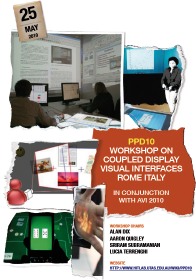
The PPD10 workshop on Coupled Display Visual Interfaces1 followed on from a previous event, PPD08 at AVI 2008 and also a workshop on “Designing And Evaluating Mobile Phone-Based Interaction With Public Displays” at CHI2008.  The linking of public and private displays is something I’ve been interested in for some years and it was exciting to see some of the kinds of scenarios discussed at Lancaster as potential futures some years ago now being implemented over a range of technologies.  Many of the key issues and problems proposed then are still to be resolved and new ones arising, but certainly it seems the technology is ‘coming of age’.  As well as much work filling in the space of interactions, there were also papers that pushed some of the existing dimensions/classifications, in particular, Rasmus Gude’s paper on “Digital Hospitality” stretched the public/private dimension by considering the appropriation of technology in the home by house guests.  The full proceedings are available at the PPD10 website.

AVI 2010

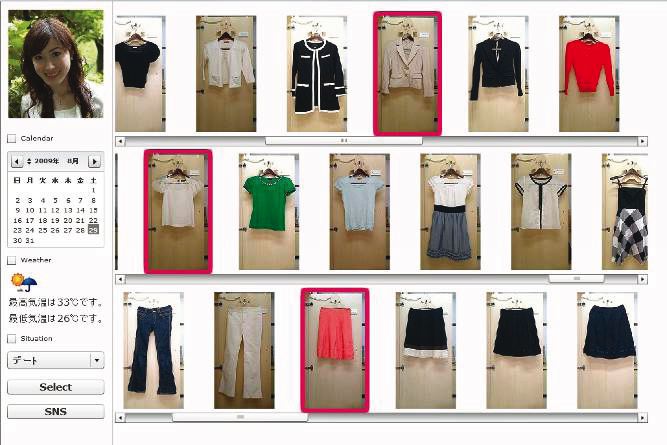
AVI is always a joy, and AVI 2010 no exception; a biennial, single-track conference with high-quality papers (20% accept rate this year), and always in lovely places in Italy with good food and good company!  I first went to AVI in 1996 when it was in Gubbio to give a keynote “Closing the Loop: modelling action, perception and information“, and have gone every time since — I always say that Stefano Levialdi is a bit like a drug pusher, the first experience for free and ever after you are hooked! The high spot this year was undoubtedly Hitomi Tsujita’s “Complete fashion coordinator2, a system for using social networking to help choose clothes to wear — partly just fun with a wonderful video, but also a very thoughtful mix of physical and digital technology.


images from Complete Fashion Coordinator

The keynotes were all great, Daniel Keim gave a really lucid state of the art in Visual Analytics (more later) and Patrick Lynch a fresh view of visual understanding based on many years experience and highlighting particularly on some of the more immediate ‘gut’ reactions we have to interfaces.  Daniel Wigdor gave an almost blow-by-blow account of work at Microsoft on developing interaction methods for next-generation touch-based user interfaces.  His paper is a great methodological exemplar for researchers combining very practical considerations, more principled design space analysis and targeted experimentation.

Looking more at the detail of Daniel’s work at Microsoft, it is interesting that he has a harder job than Apple’s interaction developers.  While Apple can design the hardware and interaction together, MS as system providers need to deal with very diverse hardware, leading to a ‘least common denominator’ approach at the level of quite basic touch interactions.  For walk-up-and use systems such as Microsoft Surface in bar tables, this means that users have a consistent experience across devices.  However, I did wonder whether this approach which is basically the presentation/lexical level of Seeheim was best, or whether it would be better to settle at some higher-level primitives more at the Seeheim dialog level, thinking particularly of the way the iPhone turns pull down menus form web pages into spinning selectors.  For devices that people own it maybe that these more device specific variants of common logical interactions allow a richer user experience.

The complete AVI 2010 proceedings (in colour or B&W) can be found at the conference website.

The very last session of AVI was a panel I chaired on “Visual Analytics: people at the heart of data” with Daniel Keim, Margit Pohl, Bob Spence and Enrico Bertini (in the order they sat at the table!).  The panel was prompted largely because the EU VisMaster Coordinated Action is producing a roadmap document looking at future challenges for visual analytics research in Europe and elsewhere.  I had been worried that it could be a bit dead at 5pm on the last day of the conference, but it was a lively discussion … and Bob served well as the enthusiastic but also slightly sceptical outsider to VisMaster!

As I write this, there is still time (just, literally weeks!) for final input into the VisMaster roadmap and if you would like a draft I’ll be happy to send you a PDF and even happier if you give some feedback :-)

Search Computing

I was invited to go to this one-day workshop and had the joy to travel up on the train from Rome with Stu Card and his daughter Gwyneth.

The search computing workshop was organised by the SeCo project. This is a large single-site project (around 25 people for 5 years) funded as one of the EU’s ‘IDEAS Advanced Grants’ supporting ‘investigation-driven frontier research’.  Really good to see the EU funding work at the bleeding edge as so many national and European projects end up being ’safe’.

The term search computing was entirely new to me, although instantly brought several concepts to mind.  In fact the principle focus of SeCo is the bringing together of information in deep web resources including combining result rankings; in database terms a form of distributed join over heterogeneous data sources.

The work had many personal connections including work on concept classification using ODP data dating back to aQtive days as well as onCue itself and Snip!t.  It also has similarities with linked data in the semantic web word, however with crucial differences.  SeCo’s service approach uses meta-descriptions of the services to add semantics, whereas linked data in principle includes a degree of semantics in the RDF data.  Also the ‘join’ on services is on values and so uses a degree of run-time identity matching (Stu Card’s example was how to know that LA=’Los Angeles’), whereas linked data relies on URIs so (again in principle) matching has already been done during data preparation.  My feeling is that the linking of the two paradigms would be very powerful, and even for certain kinds of raw data, such as tables, external semantics seems sensible.

One of the real opportunities for both is to harness user interaction with data as an extra source of semantics.  For example, for the identity matching issue, if a user is linking two data sources and notices that ‘LA’ and ‘Los Angeles’ are not identified, this can be added as part of the interaction to serve the user’s own purposes at that time, but by so doing adding a special case that can be used for the benefit of future users.

While SeCo is predominantly focused on the search federation, the broader issue of using search as part of algorithmics is also fascinating.  Traditional algorithmics assumes that knowledge is basically in code or rules and is applied to data.  In contrast we are seeing the rise of web algorithmics where knowledge is garnered from vast volumes of data.  For example, Gianluca Demartini at the workshop mentioned that his group had used the Google suggest API to extend keywords and I’ve seen the same trick used previously3.  To some extent this is like classic techniques of information retrieval, but whereas IR is principally focused on a closed document set, here the document set is being used to establish knowledge that can be used elsewhere.  In work I’ve been involved with, both the concept classification and folksonomy mining with Alessio apply this same broad principle.

The slides from the workshop are appearing (but not all there yet!) at the workshop web page on the SeCo site.


  1. yes I know this doesn’t give ‘PPD’ this stands for “public and private displays” [back]
  2. Hitomi Tsujita, Koji Tsukada, Keisuke Kambara, Itiro Siio, Complete Fashion Coordinator: A support system for capturing and selecting daily clothes with social network, Proceedings of the Working Conference on Advanced Visual Interfaces (AVI2010), pp.127–132. [back]
  3. The Yahoo! Related Suggestions API offers a similar service. [back]

August 3, 2009

data types and interpretation in RDF

Filed under: academic, web development — alan @ 1:46 pm

After following a link from one of Nad’s tweets, read Jeni Tennison’s “SPARQL & Visualisation Frustrations: RDF Datatyping“.  Jeni had been having problems processing RDF of MP’s expense claims, because the amounts were plain RDF strings rather than as typed numbers.  She  suggests some best practice rules for data types in RDF based on the underlying philosophy of RDF that it should be self-describing:

  • if the literal is XML, it should be an XML literal
  • if the literal is in a particular language (such as a description or a name), it should be a plain literal with that language
  • otherwise it should be given an appropriate datatype

These seem pretty sensible for simple data types.

In work on the TIM project with colleagues in Athens and Rome, we too had issues with representing data types in ontologies, but more to do with the status of a data type.  Is a date a single thing “2009-08-03T10:23+01:00″, or is it a compound [[date year="2009" month="8" ...]]?

I just took a quick peek at how Dublin Core handles dates and see that the closest to standard references1 still include dates as ‘bare’ strings with implied semantics only, although one of the most recent docs does say:

It is recommended that RDF applications use explicit rdf:type triples …”

and David MComb’s “An OWL version of the Dublin Core” gives an alternative OWL ontology for DC that does include an explicit type for dc:date:

<owl:DatatypeProperty rdf:about="#date">
  <rdfs:domain rdf:resource="#Document"/>
  <rdfs:range rdf:resource="http://www.w3.org/2001/XMLSchema#dateTime"/>
</owl:DatatypeProperty>

Our solution to the compound types has been to have “value classes” which do not represent ‘things’ in the world, similar to the way the RDF for vcard represents  complex elements such as names using blank nodes:

<vCard:N rdf:parseType="Resource">
  <vCard:Family> Crystal </vCard:Family>
  <vCard:Given> Corky </vCard:Given>
  ...
</vCard:N>

From2

This is fine, and we can have rules for parsing and formatting dates as compound objects to and from, say, W3C datetime strings.  However, this conflicts with the desire to have self-describing RDF as these formatting and parsing rules have to be available to any application or be present as reasoning rules in RDF stores.  If Jeni had been trying to use RDF data coded like this she would be cursing us!

This tension between representations of things (dates, names) and more semantic descriptions is also evident in other areas.  Looking again at Dublin Core the metamodal allows a property such as “subject”  to have a complex object with a URI and possibly several string values.

Very semantic, but hardly mashes well with sources that just say <dc:subject>Biology</dc:subject>.  Again a reasoning store could infer one from the other, but we still have issues about where the knowledge for such transformations resides.

Part of the problem is that the ’self-describing’ nature of RDF is a bit illusary.   In (Piercian) semiotics the interpretant of a sign is crucial, representations are interpreted by an agent in a particular context assuming a particular language, etc.  We do not expect human language to be ’sef describing’ in the sense of being totally acontextual.  Similarly in philosophy words and ideas are treated as intentional, in the (not standard English) sense that they refer out to something else; however, the binding of the idea to the thing it refers to is not part of the word, but separate from it.  Effectively the desire to be self-describing runs the risk of ignoring this distinction3.

Leigh Dodds commented on Jeni’s post to explain that the reason the expense amounts were not numbers was that some were published in non-standard ways such as “12345 (2004)”.  As an example this captures succinctly the perpetual problem between representation and abstracted meaning.  If a journal article was printed in the “Autumn 2007″ issue of  quarterly magazine, do we express this as <dc:date>2007</dc:date> or <dc:date>2007-10-01</dc:date>  attempting to give an approximation or inference from the actual represented date.

This makes one wonder whether what is really needed here is a meta-description of the RDF source (not simply the OWL as one wants to talk about the use of dc:date or whatever in a particular context) that can say things like “mainly numbers, but also occasionally non-strandard forms”, or “amounts sometimes refer to different years”.  Of course to be machine mashable there would need to be an ontology for such annotation …


  1. see “Expressing Simple Dublin Core in RDF/XML“, “Expressing Dublin Core metadata using HTML/XHTML meta and link elements” and Stanford DC OWL [back]
  2. Renato Iannella, Representing vCard Objects in RDF/XML, W3C Note, 22 February 2001. [back]
  3. Doing a quick web seek, these issues are discussed in several places, for example: Glaser, H., Lewy, T., Millard, I. and Dowling, B. (2007) On Coreference and the Semantic Web, (Technical Report, Electronics & Computer Science, University of Southampton) and Legg, C. (2007). Peirce, meaning and the semantic web (Paper presented at Applying Peirce Conference, University of Helsinki, Finland, June 2007). [back]

June 24, 2009

going SIOC (Semantically-Interlinked Online Communities)

Filed under: academic, web development — alan @ 2:31 pm

I’ve just SIOC enabled this blog using the SIOC Exporter for WordPress by Uldis Bojars.  Quoting from the SIOC project web site:

The SIOC initiative (Semantically-Interlinked Online Communities) aims to enable the integration of online community information. SIOC provides a Semantic Web ontology for representing rich data from the Social Web in RDF.

This means you can explore the blog as an RDF Graph including this post.

<sioc:Post rdf:about="http://www.alandix.com/blog/?p=176">
    <sioc:link rdf:resource="http://www.alandix.com/blog/?p=176"/>
    <sioc:has_container rdf:resource="http://www.alandix.com/blog/index.php?sioc_type=site#weblog"/>
    <dc:title>going SIOC (Semantically-Interlinked Online Communities)</dc:title>
    <sioc:has_creator>
        <sioc:User rdf:about="http://www.alandix.com/blog/author/admin/" rdfs:label="alan">
            <rdfs:seeAlso rdf:resource="http://www.alandix.com/blog/index.php?sioc_type=user&amp;sioc_id=1"/>
        </sioc:User>
    </sioc:has_creator>
...

April 19, 2009

RDF sequences … could they be more semantic?

Filed under: academic, web development — alan @ 12:00 pm

Although triples can in principle express anything (well anything computational), this does not mean they are particularly appropriate for everything1.

RDF sequences are one of the most basic structured types and I have always found the use of rdf:_1, rdf:_2 at best clunky.  In particular I don’t like the fact that the textual form embodies the meaning.

In the RDF schema, rdf:_1, rdf:_2, etc are all instances of the class rdfs:ContainerMembershipProperty and sub-properties of rdfs:member.  However, I was also looking to see if there was some (implicitly defined) property of each of them that said which index they represented.  For example:

<rdf:_3> <rdf:isSequenceNumber> “3″

This would mean that the fact that rdf:_3 corresponded to the third element in a sequence was expressed semantically by rdf:isSequenceNumber as well as lexically in the label “_3″.

Sadly I could find no mention of this or any alternative technique to give the rdf:_nnn properties explicit semantics :-(

This is not just me being a purist,  having explicit semantics makes it possible to express queries such as gathering together contiguous pairs in a sequence:

<ex:a> ?r1 ?a.
<ex:a> ?r2 ?b.
?r1 <rdf:hasSequenceNumber> ?index.
?r2 <rdf:hasSequenceNumber> ?index + 1.

Without explicit semantics, this would need to be expressed using string concatenation to create the labels for the relations – yuck!

Have I missed something? Is there an alternative mechanism in the RDF world that is like this or better?

Mind you I don’t see what’s wrong with a[index] … but may be that is just too simple?


  1. see also previous posts on “It-ness and identity: FOAF, RDF and RDMS” and “digging ourselves back from the Semantic Web mire“ [back]

October 23, 2008

web of data practioner’s days

Filed under: HCI and usability, academic, web development — alan @ 9:54 am

I am at the Web of Data Practitioners Days (WOD-PD 2008) in Vienna.  Mixture of talks and guided hands-on sessions.  I presented first half of session on “Using the Web of Data” this morning with focus (surprise) on the end user. Learnt loads about some of the applications out there – in fact Richard Cyganiak .  Interesting talk from a guy at the BBC about the way they are using RDF to link the currently disconnected parts of their web and also archives.  Jana Herwig from Semantic Web Company has been live blogging the event.

Being here has made me think about the different elements of SemWeb technology and how they individually contribute to the ‘vision’ of Linked Data.  The aim is to be able to link different data sources together.  For this having some form of shared/public vocabulary or ‘data definitions’ is essential as is some relatively uniform way of accessing data.  However, the implementation using RDF or use of SPARQL etc. seems to be secondary and useful for some data, but not other forms of data where tabular data may be more appropriate.  Linking these different representations  together seems far more important than specific internal representations.  So wondering whether there is a route to linked data that allows a more flexible interaction with existing data and applications as well as ’sucking’ in this data into the SemWeb.  Can the vocabularies generated for SemWeb be used as meta information for other forms of information and can  query/access protocols be designed that leverage this, but include broader range of data types.

June 13, 2008

local URIs … mashing up the desktop

Filed under: HCI and usability, academic, web development — alan @ 3:42 pm

I’ve worried for a while about desktop URLs.

Within the web it is easy to link things together. If I want to refer to my home page I just add a link like this. However, on the desktop things are not so simple and I end up copying chunks of mail messages into the notes field in iCal rather than simply being able to link to the mail message where I arranged the meeting.

Links from the desktop to the web are easy … just use the URL … many desktop applications including mail clients and word processors will allow you to embed clickable links. Indeed it is often easier to link to a web page than to another object on the desktop! However, things get more difficult if you want to link the other way round, from a web page to a local file or resource. In my browser’s favourites I have several links to local files, but you cannot easily do the same if your bookmarks are in a web service like del.icio.us or even my own Snip!t. It is hard to seamlessly weave your desktop into the global web.

A couple of events brought this issue to a head for me.

First at the CHI workshop on PIM entitled the Disappearing Desktop, I asked if anyone knew of work in the area and I heard from Leo Sauermann that they had made some progress on this as part of the Gnowsis project. Their proposal for a Desktop URI Scheme (edited by Leo) is targeted principally at the first of the scenarios above, being able to link between things within the desktop.

The second event was at the AVI workshop on designing multi-touch interaction techniques for coupled public and private displays. During discussions abut touch-based interactions such as the Microsoft Surface or Apple iPhone, we considered scenarios where peole got together for a meeting (as we were) in a hotel bar (where we split for small group discussion) and had screens on table tops and walls, laptops, tablets, phones … and wanted to seamlessly move material between devices. Clearly an essential requirement for which is some way to identify resources across ad hoc collections of devices.

Finally I was in Athens working with George Lepouras, Akrivi Katifori and others. George had developed a Thunderbird extension to allow Snip!t to snip from mail messages … but while we could snip the text there was no way for the Snip!t page to link back to the mail message. We need full round trip URIs that link desktop and web with no distinction – URIs that can be embedded in a web page and (assuming you have the right permissions and are in an appropriate place) can be clicked and the appropriate mail message, calendar entry or whatever is opened.

Based on this and discussions we had, I drafted a discussion document on globally accessible local URIs. Any feedback very welcome.

Over the summer we hope to put together a demonstrator / reference implementation – if anyone is interested let me know.

March 18, 2008

It-ness and identity: FOAF, RDF and RDMS

Filed under: academic, web development — alan @ 8:25 am

Issues of ’sameness’ are the underpinnings of any common understanding; if I talk about America, bananas or Caruso, we need to know we are talking about the ’same’ thing.

Codd’s relational calculus was unashamedly phenomenological – if two things have the same attributes they are the same. Of course in practice, we often have things which look the same and yet we know are different: two cans of beans, two employees called David Jones. So many practical SQL database designs use unique ids as the key field of a table effectively making sure that otherwise identical rows are distinct1.

The id gives a database record identity – it is a something independent of its attributes.

I usually call this quality ‘it-ness’ and struggled to find appropriate (probably German) philosophical term to refer to it. Before we can point at something and say ‘it is a chair’, it must be an ‘it’ something we can refer to. This it-ness must be there before we consider the proeprties of ‘ot’ (legs, seat, etc.). It-ness is related to the substance/accident distinction important in medieval scholastic debate on transubstantiation, but different as the bread needs to be an ‘it’ before we can say that its real nature (substance) is different from its apparent nature (accidents).

In contrast RDF takes identity, as embodied in a URI, as its starting point. The origins of RDF are in web meta-data – talking about web pages … that is RDF is about talking about something else, and that something else has some form of (unique) identity. Although the word ‘ontology’ seems to be misused almost beyond recognition in computer science, here we are talking about true ontology. RDF assumes as a starting point it is discussing things that are, that exist, that have being. Given this of course several distinct things may have similar attributes2.

Whilst RDMS have problems talking about identity, and we often have to add artifices (like the id), to establish identity, in RDF the opposite problem arises. Often we do not have unique names even for web entities, and even less when we have RDF descriptions of people, places … or books. Nad discusses some of the problems of cleaning up book data (MARC, RDF and FRMR), part of which is establishing unique names … and really books are ‘easy’ as librarians have soent a long time thinking about idetifying them already.

FOAF (friend of a friend) is now widely used to represent personal relationships. In this Wordpress blog, when I add blogroll entries it prompts for FOAF information: is this a work colleague, family, friend (but not foe or competitor … FOAF is definitely about being friendly!).

FOAF has an RDF format, but examples, both in practice … and in the XMLNS RDF specification, are not full of “rdf:about” links as are typical RDF documents. This is because, while people clearly do have unique identity, there is thankfully no URI scheme that uniquely and universally defies us3.

In practice FOAF says things like “there is a person whose name is John Doe”, or “the blog VirtualChaos is by a person who is a friend and colleague of the author of this blog”.

In terms of identity this is a blank node “the person who …”. The computational representation of the person is a placeholder, or a variable waiting to be associated with other placeholders.

In terms of phenomenological attributes, the values either do not uniquely identify an individual (here may be many John Doe’s) and the individual may have several potential values for a given attribute (John Doe may not be the body’s only name,and a person may have several email addresses).

In order to match individuals in FOAF, we typically need to make assumption: while I may have several email addresses, they are all personal, so if two people have the same email address they are the same person. Of course such reasoning is defeasible: some families share an email address, but serves as a way of performing partial and approximate matching.

I think to the semantic web purist the goal would be to have the unique personal URI. However, to my mind the incomplete, often vague and personally defined FOAF is closer to the way the real world works even when ontologically there is a unique entity in the world that is the subject. FOAF challenges simplistic assumptions and representations of both a phenomenological and ontological nature.


  1. Furthermore if you do not specify a key, RDMS are likely to treat a relation as bag rather than a set of tuples! Try inserting the same record twice. [back]
  2. For those who know their quantum mechanics RDMS records are like Fermions and obey Pauli exclusion principle, whilst RDF entities are like Bosons and several entities can exist with identical attributes. [back]
  3. As it says in The Prisoner “I am not a number” … although maybe one day soon we will all be biometrically identified and have a global URI :-/ [back]

February 23, 2008

practical RDF

Filed under: academic, web development — alan @ 3:13 pm

I just came across D2RQ, a notation (plus implementation) for mapping relational databases to RDF, developed over the last four years by Chris Bizer, Richard Cyganiak and others at Freie Universität Berlin. In a previous post, “digging ourselves back from the Semantic Web mire“, I worried about the ghetto-like nature of RDF and the need for “abstractions that make non-triple structures more like the Semantic Web”, D2RQ is exactly the sort of thing, allowing existing relational databases to be accessed (but not updated) as if they were and RDF triple stores, including full SPARQL queries.

As D2RQ has clearly been around for years, I tried to do a bit of a web search to find things the other way around – more programmer-friendly layers on top of RDF (or XML) allowing it to be manipulated with IDL-like or other abstractions closer to ‘normal’ programming. ECMAScript for XML (E4X) seems to be just this allowing reasonably easy access to XML (but I guess RDF would be ‘flat’ in this). E4X has been around a few years (standard since 2005), but as far as I can see not yet in IE (surprise!). I guess for really practical XML it would be JSON, and there’s a nice discussion of different RDF in JSON representation issues on the n2 wiki “RDF JSON Brainstorming“. However, both E4X and RDF in JSON still are just accessing RDF nicely not adding higher level structure.

Going back to the beginning I was wondering about any tools that represent RDF as SQL / RDMS in order to make it available to ‘old technology’ … but then remembered that SPARQL creates tuples not triples so, I guess, one could say that is exactly what it does :-/

December 13, 2007

Usabilty and Web2.0

Filed under: HCI and usability, academic, web development — alan @ 11:33 am

Nad did a brilliant guest lecture for our undergraduate HCI class at Lancaster on Monday. His slides and blog about the lecture are at Virtual Chaos. He touched on issues of democracy vs. authority of information, dynamic content vs. accessibility and of course increasing issues of privacy on social networking sites. He also had awesome slides to using loads of Flickr photos under creative commons … community content in action not just words! Of course also touched on Web3.0 and future convergence between emergent community phenomena and structured Semantic Web technologies.

Next Page »

Powered by WordPress