Alan’s blog

February 17, 2010

names – a file by any other name

Filed under: HCI and usability, academic, web development — alan @ 4:55 pm

Naming things seems relatively unproblematic until you try to do it — ask any couple with a baby on the way.  Naming files is no easier.

Earlier today Fiona @lovefibre was using the MAC OS Time Machine to retrieve an old version of a file (let’s call it “fisfile.doc”).  She wanted to extract a part that she knew she had deleted in order to use in the current version.  Of course the file you are retrieving has the same name as the current file, and the default is to overwrite the current version; that is a simple backup restore.  However, you can ask Time Machine to retain both versions; at which point you end up with two files called, for example, “fisfile.doc” and “fisfile-original.doc”.  In this case ‘original’ means ‘the most recent version’ and the unlabelled one is the old version you have just restored.  This was not  too confusing, but personally I would have been tempted to call the restored file something like “fisfile-2010-01-17-10-33.doc”, in particular because one wonders what will happen if you try to restore several copies of the same file to work on, for example, to work out when an error slipped into a document.

OK, just an single incident, but only a few minutes later I had another example of problematic naming.

(more…)

July 10, 2009

grammer aint wot it used two be

Filed under: HCI and usability, academic, personal, web development — alan @ 10:35 am

Fiona @ lovefibre and I have often discussed the worrying decline of language used in many comments and postings on the web. Sometimes people are using compressed txtng language or even leetspeak, both of these are reasonable alternative codes to ‘proper’ English, and potentially part of the natural growth of the language.  However, it is often clear that the cause is ignorance not choice.  One of the reasons may be that many more people are getting a voice on the Internet; it is not just the journalists, academics and professional classes.  If so, this could be a positive social sign indicating that a public voice is no longer restricted to university graduates, who, of course, know their grammar perfectly …

Earlier today I was using Google to look up the author of a book I was reading and one of the top links was a listing on ratemyprofessors.com.  For interest I clicked through and saw:

“He sucks.. hes mean and way to demanding if u wanan work your ass off for a C+ take his class1

Hmm I wonder what this student’s course assignment looked like?

(more…)


  1. In case you think I’m a complete pedant, personally, I am happy with both the slang ’sucks’ and ‘ass’ (instead of ‘arse’!), and the compressed speech ‘u’. These could be well-considered choices in language. The mistyped ‘wanna’ is also just a slip. It is the slightly more proper “hes mean and way to demanding” that seems to show  general lack of understanding.  Happily, the other comments, were not as bad as this one, but I did find the student who wanted a “descent grade” amusing :-) [back]

February 13, 2009

European working time directive 2012 – the end of the UK university?

Filed under: academic, personal — alan @ 2:19 pm

Fiona @ lovefibre just forwarded me a link to a petition about retained firefighters, who evidently may be at risk as the right to opt out of European working time directive is rescinded.  Checking through to the Hansard record, it seems this is really a precautionary debate as the crunch is not until 2012.

However, I was wondering how that was going to impact UK academia if, in 2012, the 48 hour maximum cuts in.

It may make no difference if academics are not required to work more than 48 hours, just decide to do so voluntarily.  However, this presumably has all sorts of insurance ramifications – if we do a reference or paper outside the ‘official hours’ would we be covered by the University’s professional indemnity.  I guess also, in considering promotions and appointments, we would  have to ‘downgrade’ someone’s publications etc. to only include those that were done during paid working hours otherwise we would effectively be making the extra hours a requirement (as we currently do).

The university system has become totally dependent on these extra hours.  In a survey in the early 1990s the average hours worked were over 55 per week, and in the 15 years since then this has gone up substantially. I would guess now the average is well over 60, with many academics getting close to double the 48 hour maximum. I recall one colleague, who had recently had a baby, mentioning how he had cut back on work; now he stops work at 5pm … and doesn’t start again until 7:30pm, his ‘cut back’ week was still way in excess of 60 hours even with a young baby1. Worryingly this has spread beyond the academics and  departmental administrators are often at their desks at 7 or 8 o’clock in the evening, taking piles of work home and answering email through the weekend.  While I admire and appreciate their devotion, one has to wonder at the impact on their personal lives.

So, at a human level, enforcing limited working hours would be no bad thing; certainly many companies force this, forbidding work out of office hours.  However, practically speaking,  if the working time directive does become compulsory in 2012, I  cannot imagine how the University system could continue to function.

And … if you are planning to do a 3 year course, start now; who knows what things will be like after 3 years!


  1. Yea, and I know I can’t talk, as an inveterate workaholic I ‘cut back’ from a high of averaging 95 hours a few years ago and now try to keep around 80 max.  I was however very fortunate in that I was doing a PhD and then personal fellowships when our children were small, so was able to spend time with them and only later got mired in the academic quicksands. [back]

August 12, 2008

eprints: relaxed and scalable interfaces

Filed under: HCI and usability, academic — alan @ 10:44 pm

A story, a bit of a moan … and then I hope some constructive ideas .

It is time for the University annual report, which includes a list of all publications across the University. In previous years this was an easy job. I keep an up-to-date web page with all my publications for each year, so I simply gave our secretaries a link to the web publication list, they cut and paste it into Word, tidied the format a little … and job done. However, this year things are different … a short while ago the department installed an EPrints server. This year the department is making its submission to the University by downloading from the EPrints server, which means we have to upload to it :-/

The citation adding page runs to several screen fulls including breaking author names down into surname forename … the thought of that was somewhat daunting.

Fortunately you can import into EPrints from BibTeX and EndNote bibliographies … unfortunately mine is in plain HTML :-(

Now the 10 million AKT project that Southampton was a lead partner in developed a free text bibliography server … but, unfortunately, not included in EPrints :-(

So a few regular expression substitutions and a lot of hand edits later and I convert my 2007 pub list into BibTeX (actually couple of hours in total including ‘bug fixing’ syntax errors in the BibTeX).

Then upload the clean .bib file … beautiful – I get a list of all the uploaded items … but they are my ‘user workspace’ and not properly deposited. This I have to do one-by-one and not allowed to do so until I have filled in various additional fields, scattered liberally over several forms including one form for adding subjects that requires several clicks to open up a lovely tree browser that in the end has only 2 leaves.

Now after grouching the lessons.

There seems to be a few key problems:

(1) First the standard usability issues: the inclusion pages are oriented around the data in the system not the user, there are no shortcuts for previously entered authors, etc.

(2) The system will not allow data to be entered if it is not complete. Of course the institution wants full data (e.g. whether it is refereed, etc.), but making it difficult to enter data makes it likely that user will not bother. That is the alternative to perfect data may be no data!

(3) The interface to enter and edit is fine for a small number of entries, but becomes a pain when processing a complete publication list. Contrarily, the page for setting the subject categories is designed for handling large trees of categories but does not gracefully handle a small number.

Both (2) and (3) are also common problems, but not so well considred in usability iterature.

A useful inofmration systems heuristic that I often advocate is

“don’t enforce consistency, but highlight inconsistency”

In this case why not allow me to deposit incomplete records and then leave me a ‘to do list’ page … yes and maybe even badger me periodically with automatic emails to check it.

Anther maxim that applies to (2) is:

“Make it easy for the user to do what you want”

If you want people to upload references make it as easy as possible to do so. Now I’m sure the designers intend this to be the case, but it is easy sometimes to focus on usability of individual screens and interactions rather than the wider context.

In fact, this was the second time that I was faced with problem (3) today. Fiona had accidentally double clicked a large number of archived files when she was trying to drag them to Trash. She had to kill the application as it blindly started to open dozens of files (why not ask?). However, it was clearly coded resiliently and kept backup copies of the files it had started to open, so, when she tried to re-open it, InDesign started to ask her whether she wanted to recover the files … but did so one-by-one and wouldn’t let her do anything else until she had laboriously answered every dialogue box.

In this case the solution is fairly obvious, if there are many (or even ore than one) files to be recovered why not list them and aks about them all, perhaps with check boxes so you can recover some but not others. In general tabular or list-style views tend to work better with large numbers of items, allowing you to perform edits to many items in a single transaction.

Similarly in EPrints, after the import there were just a few fields required for each entry, some form of tabular view would have allowed me to scan down the link and select ‘refereed/not refereed’ for each entry.

With the subject categories, it was in a sense the opposite problem, but a symptom of the way we, as designers, often have some idea in out heads about how large a particular set is likely to be and then design around that idea. However, if you can notice this tendency one can often produce variant interaction styles depending on the size of the set. For example, in web-based systems to browse hierarchies I have often (but not always!) added code that effectively says, “if the number of entries at this level is not to great, then show this level as headings with the next level as well.”
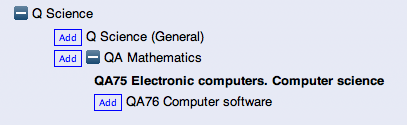

fully expanded EPrints subjects menu

The EPrints server clearly expects that the subject tree will be far bigger, as it would be on a University-wide installation. Although even if the list is very large the number of items used by an individual would be small.

So as general design advice, if there is some form of collection:

  • are there any absolute lower or upper bounds on the size?
  • check, within these absolute bounds, what the interface would be like with 1, 3, 10, 100, 1000 in the collection
  • if the potential collection is large, is the likely size needed for a particular usre, situation, smaller?

To be fair I am an unusual user with my pretty complete HTML publication lists, if I had no systematic way of keeping my own publications then I would appreciate EPrints more. However, there will be many with word processor lists, so maybe I’m not so unusual. I assume other people just knuckle down and get on with it. So the real problem is that I am impatient user!

Which brings us to the last and most valuable piece of advice. When it comes to ussr testing cussed users are worth their weight in gold. Users that are too nice are useless,; they cope, they manage and would hate to hurt your feelings by telling you your system is not perfect. So find the nasty users, the impatient users, the ones who complain at the slightest things … they are true treasure.

February 5, 2008

material culture – textiles and technology

Filed under: academic — alan @ 9:29 pm

A couple of weeks ago I was at a ‘Long Table’ discussion on Technology and Democracy at [ space ] in Hackney. The ‘Long Table’ format was led by Lois Weaver (I now note the name although didn’t at the time) and took the form of a simulated dinner art where the participants chatted about the topic. We were invited to write on the table cloth as we posed questions or espoused viewpoints – this later became part of the Not Quite Yet exhibition opening the next day.

Because of the table cloth sitting in front of me I was reminded of the role textiles have played both as significant technology themselves and in the development of technological society. It was the spinning jenny and the cotton mills that created the industrial revolution and it was needle manufacturing that was the inspirations for Adam Smith’s division of labour. In the context of the discussion of ‘democracy and technology this is particularly poignant. Before the factories spinning and weaving were skilled cottage industries described so well in Silas Marner [G|A] and the importance of the textile factory was as more about exerting control over production than about efficiency of production.

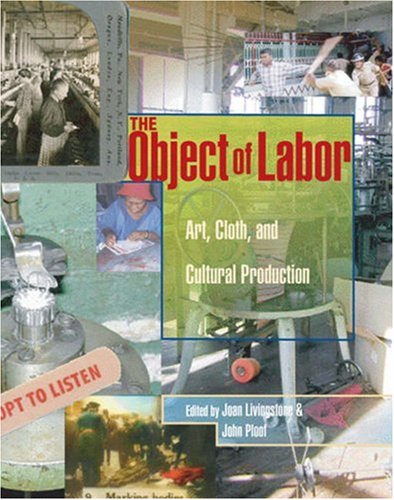
The Object of Labout - cover imageToday a book arrived from The Book Depository for Fiona “The Object of Labour: Art, Cloth and Cultural Production”. It is a majestic tome and I’m looking forward into dipping into it sometime. It says it explores the “personal, political, social, and economic meaning of work through the lens of art and textile production”. Interesting its 408 pages are covered in words and the etymology of ‘text’ itself from Latin texere to weave :-)

Somehow whilst my mind wandered over this I came to ponder the term material culture (maybe because have recently been re-reading Malfouris “The cognitive basis of material engagement” and Mike Wheeler’s response to it “Minds, Things, and Materiality“). The word ‘material’ has many meanings ‘raw materials’ for industry, ‘material evidence’ in law … but if you say the word to a person in the street ‘material’ means simply cloth. So interesting that cloth has played such a strong part in material culture and is ‘material’ itself.

This led me to wonder about the words (like text and textile) when the special meaning of material as cloth arose or even of they have different roots. Turning to the Shorter OED I looked up the definition of ‘material’. It is long, over half a column The etymology is again from Latin materia – matter – and there are meanings related to that (as in material culture), the legal and philosophical meanings, the sense of documents or sources used for writing, indeed the implements of writing ‘writing materials’ … but nowhere material as simply cloth, not even in the addenda of recent words.

The most common meaning of material, the most mundane, the one that sits next to my skin as I write – forgotten, written out of the dictionary, as the hand-loom weavers were written out of industrial production.

December 13, 2007

Physicality and Middle Ages Tech Support

Filed under: HCI and usability, academic, web development — alan @ 1:33 pm

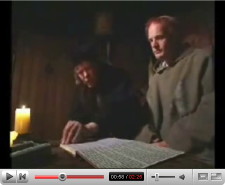
Ansgarr needing help to use a bookOn the forum of our MRes course at Lancaster one of the students posted a link to Middle Ages Tech Support on YouTube. It shows Ansgarr a Mediaeval monk struggling with his first book.

I first saw this video when I was giving a talk at University of Peloponnese in Tripolis. Georgios1 showed the video before I started, just because he thought it was fun. I was talking a little bit about physicality and the video brought up some really interesting issues relating to this and usability. Although it is a comic video we can unpack it and ask which of the problems that Ansgarr has as he changes technology from scroll to book would actually happen and which are more our own anachronistic view of the past.

(more…)


  1. one of my hosts there as part of the TIM project [back]

December 2, 2007

fading news – disks astray and children named

Filed under: academic, political — alan @ 9:23 am

This is now old news (it takes me a long time to get to the blog!), but anyone in the UK will know the story of the missing child benefit disks – 25 million records containing parents and children’s names addresses, dates of birth, bank account and national insurance details … an identity fraudsters’ gold mine. This has caused worries of millions of parents and embarrassment for Alistair Darling in Parliament. The BBC has a timeline of the events and Computer Weekly has (very) slightly more techie focused account.

Anyway a week ago last Thursday (22nd Nov) I did a short radio interview on Radio Cumbria, which forced me to consider the issue in a little more detail. I think they expected more a security angle, but obviously this is very much a human story also.

Despite the gravity of the event I was shocked but not surprised. In the end if you put people in a severely time pressured, cost-controlled context mistakes will inevitable happen.

So what went wrong? …

(more…)

August 20, 2007

more tibbies

Filed under: personal — alan @ 6:09 pm

As I just wrote about a Tibetan spaniel I thought I ought to add a picture of our Tibetan spaniel, Tansy, in case she gets jealous.

Tansy in purple

drawing by Fiona at LoveFibre

Powered by WordPress