September saw two events on Tiree; both exciting but each very different: at the beginning of the month the first Tiree Ultramarathon organised by Will Wright our very own Tiree superhero and towards the end ‘Re-Thinking Architecturally‘, a workshop of the European Network of Excellence on Internet Science organised by Clare Hooper from Southampton University. I was lucky enough to take part in both.
In addition, in a few weeks time (23-27 Oct) there will be the eighth Tiree Tech Wave, which will include participants from Canada, Scotland, Wales and England (but no-one from Ireland yet). As well as the usual unstructured serendipity, we will have some tutorial workshops of 3D scanning, 3D printing and laser cutting … but more about that in another post.
The Tiree Ultra
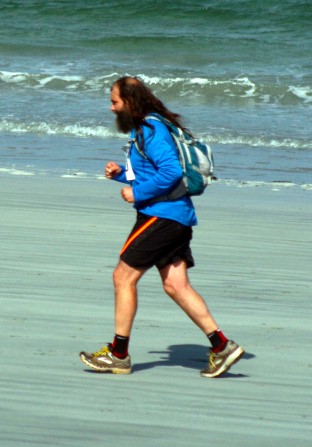
photo Rhoda Meek
I should first emphasise that I did not run all of the 35 mile ultra-marathon course around the coast of Tiree, but did about 50:50, walk/run. I’d never done anything remotely like this before. The longest I’d run was the Tiree half marathon back in May and the longest I’d walked during the Wales walk was a 29 mile day (although I did that over more than 12 hours). I had as a schoolboy once done a 34 mile day hike up into the coal valleys above Cardiff, and one of the spurs to sign up for the Ultra was to beat my 17 year old self!
With my usual level of preparation it came to the beginning of August and I realised I’d not run at all, nor even taken a walk longer than to the beach and back, since the half-marathon in May. Just before the event I found a couple of sites with training schedules for marathons, all of them were several months long and the ‘beginner’ level was “runs 15-25 miles a week regularly” … what about zero miles a week? Anyway my lengthy one month training schedule consisted mainly of short (2.5 mile) beach runs with the occasional 7.5 mile run to Hynish and towards the end a run of 8.5 miles along part of the route of the Ultra round the base of Ben Hynish. I was aware I’d not done any really substantial runs and so, rather foolishly, on the Wednesday 4 days before the event I ran (and walked!) 21 miles around part of the route on the east end of the island and down to Hynish and back. A good last run before the event, but one I should have done a week earlier.
Somehow or other, despite my foolish training schedule, I managed to get round without any serious injury. My main problem was eating, or rather failing to eat. I found I could only mange food during walking stages, and then just a small amount of Kendal Mint Cake and few bananas, I guess overall I managed to burn around 4000 calories, but ate less than 1000, which really made the legs start to tire as I got to the latter parts of the course. I’ve already entered for the 2015 Tiree Ultra next September (half the places are already gone and entries have only been open a week), but I will have to work out how to eat better before then. Crucially I got round the course … and not even last. The serious contenders managed times not much more than 4 1/2 hours whilst I got round in just over 8:20, but I was simply happy to get to the end.
Although it was further and faster than any day walking last year, it was in many ways a lot easier than the Wales walk. About 2/3 of the way round the Tiree course my right ankle and calf started to stiffen, which was where I’d had Achilles ankle problems a couple of years ago. Although I did try to ease a little I was not terribly worried; the worst would be that I’d be hobbling for a month or so after the run. In contrast, last year I knew that I would be walking again the next day, and the next,and the one after that; with each ache I worried whether it would be the injury that did not get better, and stopped the walk. And, despite the worry of this, I had also learnt quite how resilient the body is, that most pains and strains did get better, albeit slowly, despite unrelenting exercise.
I was also reminded very much of the walk when I finished. I took off my running shoes and socks, the latter sodden from beach and bog, and filled with fine layer of sand. The soles of my feet, which had been subjected to 35 miles of damp sandpaper, felt like I was walking on coals and I hobbled about between van and Ceadhar where they laid on a post-walk pizza and party. It was just like that so many days last year, I would get to where I was staying, ease off my boots, put on sandals, and then hobble out in search of food, wondering if I would get as far as the closest pub or cafe, let alone walk again the next day.
Re-thinking Architecturally
The Internet Science workshop was equally enjoyable, but a little less physically challenging! It brought together economists, architects, lawyers, policy advisors, and some with more technical background from as far afield as Umea in northern Sweden. It was lovely being able to attend a technology workshop on Tiree that I hadn’t organised 🙂
Clare had been to one of the Tiree Tech Waves, and then, when she was organising a workshop for the European Network of Excellence on Internet Science, she thought of Tiree. The logistics were not without problems, but after the event I’ve been getting together with the Tiree Trust to make an information pack for future organisers to make the process easier. So if if you would like to organise an event on Tiree, get in touch!
The participants all seemed utterly taken with the venue, several brave souls even swimming in the mornings off the Hynish pier, in the words of one of the participants on the way back after the event “I’d rather be in Tiree!”. Another said:
“one great consequence of the week in Tiree was a kind of intellectual regeneration that let me set aside the stresses of the coming academic year and…think openly a bit.”
Alison Powell (London School of Economics)
In fact this is precisely the feedback I get from many who have been to Tiree Tech Wave. It is hard to capture in words the way the open horizon and being at the wild-edge opens up the mind, especially when meeting with others equally committed to exploring new ideas freely and openly.
One of the memorable moments from the week was a debate of internet freedom and regulation. We started off half on one side half the other and then part way through we all had to swop sides. I can’t believe how passionate I got about both sides of the argument … and I managed to wheel in my school English teacher as authority on benevolent dictatorship1.
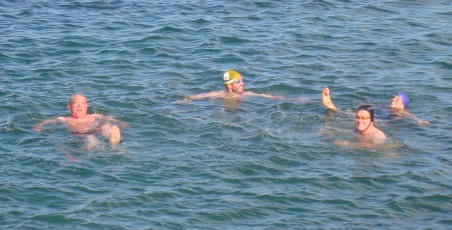 photo Parag Deshpande |
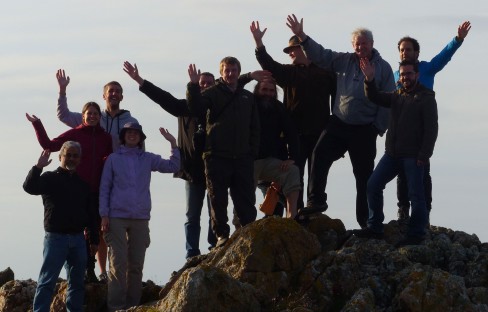 photo Rory at Balevullin |
People
While two very different events, a common story was the wonderful welcome of the people of Tiree. During the Ulta-marathon, at every way-station there was a glorious array of tray bakes, chocolates, pre-sliced fruit, and above all smiling faces. This was great for me seeing faces I knew, but clearly very special for the participants who came from afar being greeted as if they too were friends. For the Re-thinking Architecturally workshop many people made it a success: the wonderful team at the Hynish Centre, especially Lesley who kept on smiling despite a seven hour wait for participants whose travel was disrupted, everyone at Ceadhar, Ring n Ride, and at the airport re-arranging travel across Europe when the Thursday plane was cancelled.
- I wrote what I thought to be a masterful mock O’level essay that asserted that Macbeth was actually a good king taking a ‘he made the trains run on time’ argument — my English teacher, Miss Griffiths, was not impressed.[back]
 The
The 
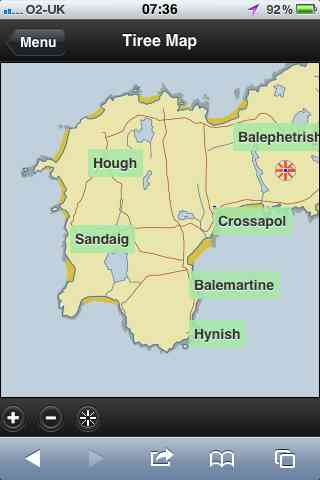






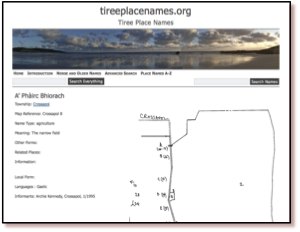
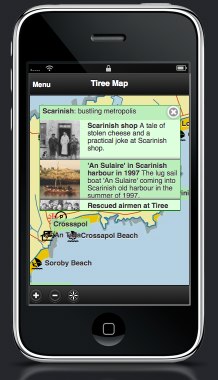
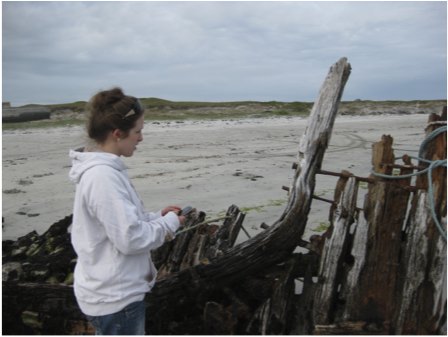 Over the next nine months we will create a mobile application allowing visitors and local historians to access geographically pertinent information, including old photographs, and interpretative maps/diagrams, while actually at sites of interest. This will largely use visitors’ own devices such as smart phones and tablets. Maps will be central to the application, using both OS OpenData and bespoke local maps and sketches of historical sites.
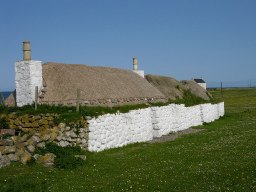
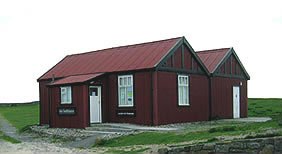
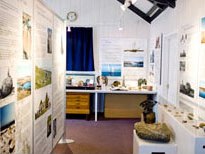
 At some remote sites such as the Tiree chapels, dating back to the 10th century, or Iron Age hill forts, there are simple information boards and at a few locations there are also fixed indoor displays, including at An Iodhlann itself. However, there are practical and aesthetic limits on the amount of large-scale external signage and limits on the ongoing running and maintenance of indoor exhibits. Furthermore, limited mobile signals mean that any mobile-based solutions cannot assume continuous access.
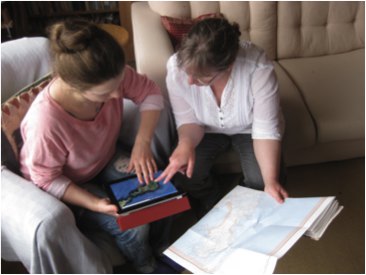 In order to deal with this, the on-the-ground experience will be combined with a web site allowing pre-trip planning and post-trip reminiscence. This will also be map focused, allowing visitors to see where they have been or are about to go, access additional resources, such as photos and audio files that are too large to be available when on the ground (remembering poor mobile coverage). This may also offer an opportunity to view social content including comments or photographs of previous visitors and then to associate one’s own photographs taken during the day with the different sites and create a personal diary, which can be shared with others.