I have become increasingly annoyed and distressed over the years at the way the media decides a narrative for various news stories and then selectively presents the facts to tell the story, ignoring or suppressing anything that suggests a more nuanced or less one-sided account.
 Sometimes I agree with the overall narrative, sometimes I don’t. Either way the B-movie Western accounts, which cannot recognise that the baddies can sometimes do good and the goodies may not be pristine, both distort the public’s view of the world and perhaps more damagingly weaken the critical eye that is so essential for democracy.
For the newspapers, we know that they have an editorial stance and I expect a different view of David Cameron’s welfare policy in The Guardian compared with The Telegraph. Indeed, I often prefer to read a newspaper I disagree with as it is easier to see the distortions when they clash with one’s own preconceptions. One of the joys of the British broadsheet press is that whatever the persuasion, the underlying facts are usually there, albeit deeply buried towards the end of a long article.
However, maybe unfairly, I have higher expectations of the BBC, which are sadly and persistently dashed. Here it seems not so much explicit editorial policy (although one hears that they do get leant upon by government occasionally), more that they believe a simplistic narrative is more acceptable to the viewer … and maybe they just begin to believe there own stories.
A typical (in the sense of terrifyingly bad) example of this appeared this morning.
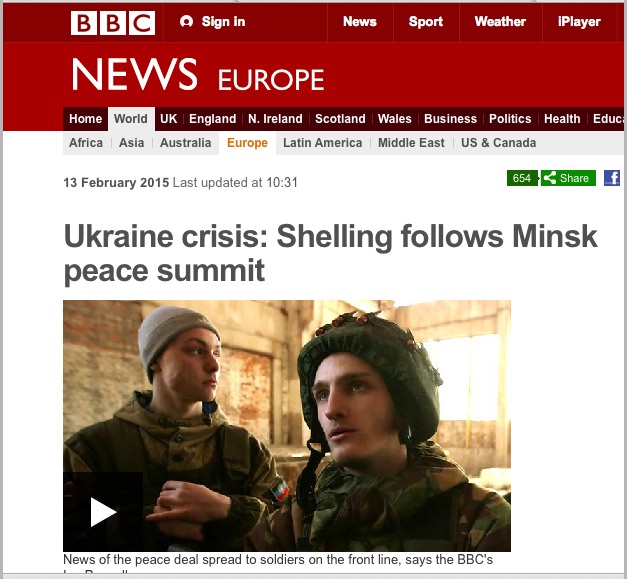
After the wonderful news of a peace agreement in Ukraine yesterday, this morning the report read:
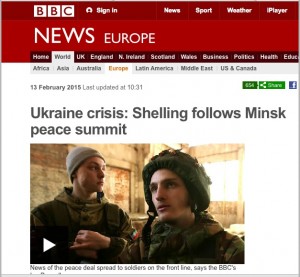
Ukraine crisis: Shelling follows Minsk peace summit
The ceasefire is due to start on Sunday, so one can only hope this is a last violent outburst, although to what avail as the borders are already set by the Minsk agreement.
The first few lines of the article read as follows:
New shelling has been reported in the rebel-held east Ukrainian cities of Donetsk and Luhansk, a day after a peace deal was reached in Minsk.
There are no confirmed reports of casualties. Both cities are near the front line where the pro-Russian rebels face government forces.
The ceasefire agreed in the Belarusian capital is to begin in eastern Ukraine after midnight (22:00 GMT) on Saturday.
The EU has warned Russia of additional sanctions if the deal is not respected.
If you have kept abreast of the ongoing crisis in Ukraine and can remember your geography, then you will know that this means the Ukrainian Army was shelling rebel-held cities. However, if you are less aware, this is not the immediate impression of the article.
First notice the passive wording of the title. Imagine if this had been Syria, the headline would have surely been “Assad’s forces bombard Syrian cities” or “Syrian Army shell civilian areas“. While the BBC may want to avoid flamboyant titles (although do not demure elsewhere) the article itself is no better.
The opening paragraphs mention ‘shelling’, ‘rebels’ and the EU warning Russians to clean up their act. The emotional and rhetorical impact is that in some way Russians are to blame for the shelling of cities, and indeed when I read the words to Fiona this was precisely what she assumed.
That is, while the facts are there, they are presented in such a way that the casual reader takes away precisely the opposite of the truth. In other words, the BBC reporting, whether intentionally or unintentionally, systematically misleads the public.
To be fair, in the earliest version of the article its later parts report first Ukrainian army deaths and then civilian casualties in rebel-held areas:
On Friday morning, a military spokesman in Kiev said eight members of Ukraine’s military had been killed in fighting against separatists in the past 24 hours.
The rebels said shelling killed three civilians in Luhansk, reported AFP news agency.
(Although the second sentence is removed from later versions of the article.)
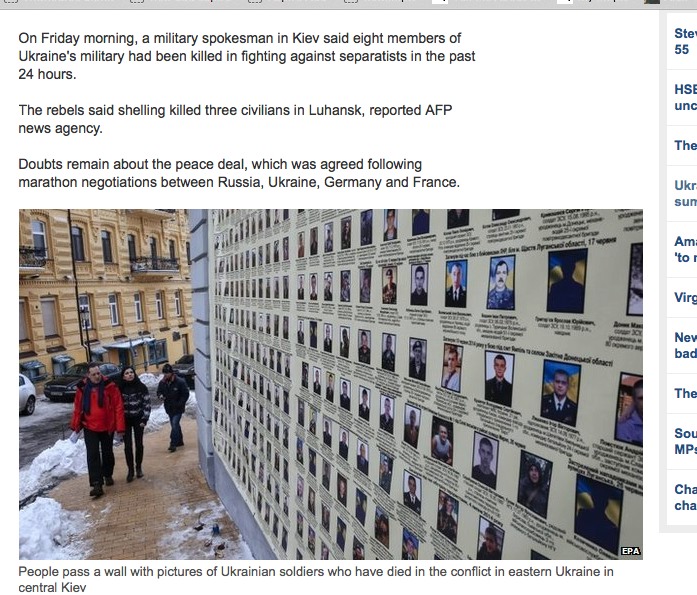
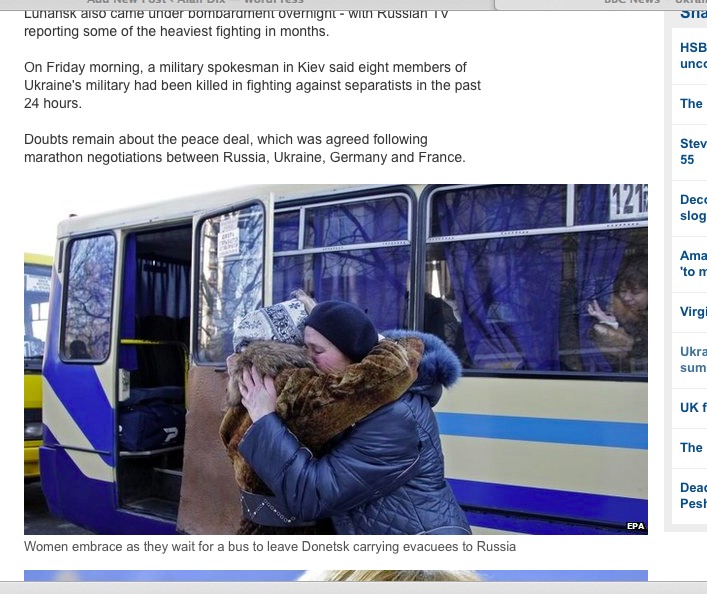
early and later version of same BBC story
The early versions of the article also included an image of a wall in Kiev commemorating Ukrainian army deaths, but not the graphic images of civilian casualties that would be used in other conflicts. This was later changed to a refugee departing on a bus to Russia ((Later still the image of an armoured vehicle was also added. I’d not realised before just how much these news stories are post-edited)), which better reflects the facet behind the article.
Of course, this is not a one-sided conflict, and later reports from the region during he day include rebel shelling of government held areas as well as government shelling. Both sides need to be reported, but the reporting practice seems to be to deliberately obfuscate the far more prevalent Ukrainian army attacks on civilian areas.
If this were just a single news item, it could be just the way things turn out, and other news items might be biased in other directions, but the misreporting is systematic and long term. Many of BBCs online news items include a short potted history of the conflict, which always says that the current conflict started with Russian annexing of Crimea, conveniently ignoring the violent overthrow of the elected government which led to this. Similarly the BBC timeline for Ukraine starts in 1991 with the Ukrainian referendum to separate from the USSR, conveniently ignoring the similar overwhelming referendum in Crimea earlier in 1991 to separate from Ukraine.
To be fair on the journalists on the ground, it is frequently clear that their own raw accounts have a different flavour to the commentary added when footage is edited back in London.
In some way Ukraine could be seen as a special case, the Russians are the bogey men of the today, just like Germany was 100 years ago and France was 100 years previously, it is hard for a journalist to say, “actually in this case they have a point“.
Yet, sadly, the above account could be repeated with different details, but the same underlying message in so many conflicts in frequent times. Will the media, and the BBC, ever trust the public with the truth, or will ‘news’ always be a B movie?

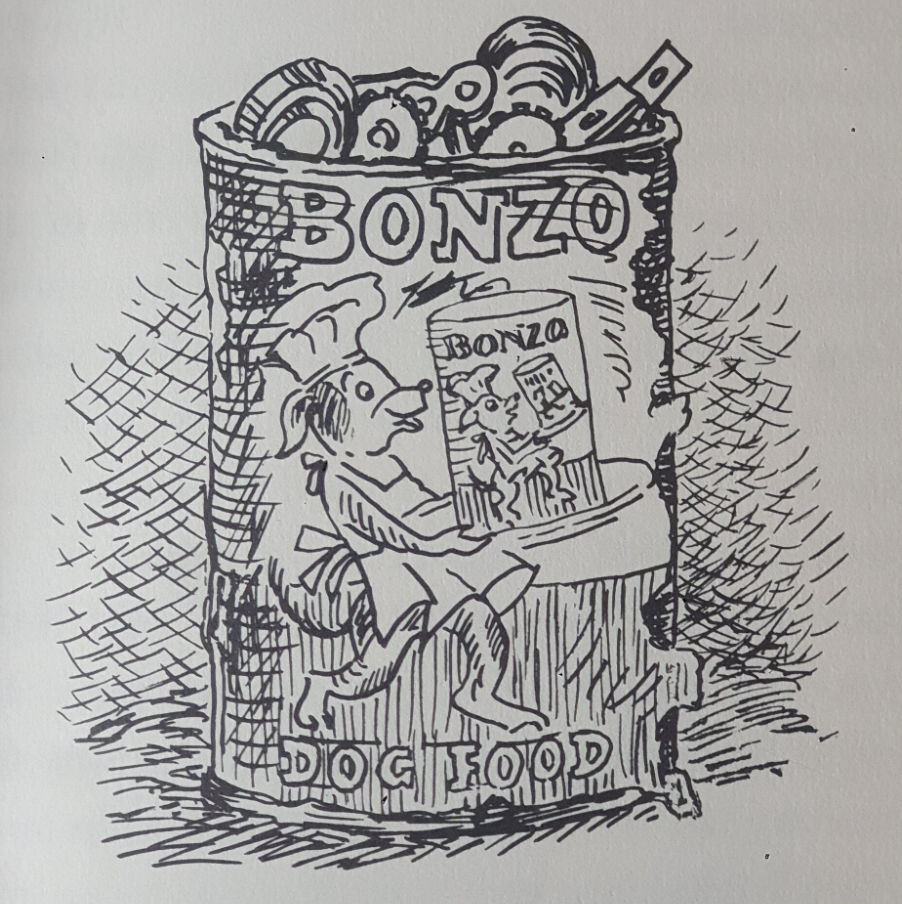




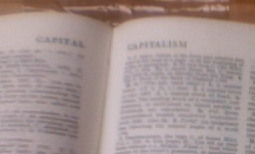 A colleague of mine recently had reviews back on a paper. One reviewer criticised the use of the term ‘capitalisation’ (which was in context referring to ‘social capital’) as to the reviewer word meant making letters upper case. The reviewer suggested that this might be a word in the author’s native language.