Alan’s blog

May 22, 2009

Last days in Rome

Filed under: academic, books, personal — alan @ 10:44 am

Five weeks in Rome seemed like a long time, but with a week mainly in Milan and Trento and the coming week in India, in fact just three full weeks and they have flown by.

I had imagined long evenings reading philosophy of the physical world, and weekend afternoons under the shade of a tree on the Palatine Hill, but it didn’t quite work out like that.

Of the ‘work’ books I brought to Rome (and borrowed here), I have only read Gibson’s “The Ecological Approach to Visual Perception“, Goodman’s “Languages of Art” and Noe’s “Action in Perception“; and of the ‘fun’ books only Tamara Pierce’s  The Healing in the Vine. I have flights back and forth to India next week, so may manage a bit more then, but mainly overnight, so I fear most of my bookshelf will return to the UK unread :-(

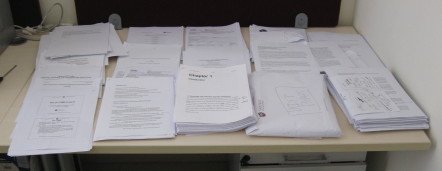
One of the reasons is evident on a table in my office. Normally at home when I finish something the paper from it ‘goes away’ somewhere, but here as I have read something or finished with printouts I have been laying them out on an empty table in case I wanted to refer to them again. So the table is now covered, smothered, in the results of three weeks normal academic work. I am amazed, if not aghast, at the volume. The entire table between 50 and 500 sheets thick in paper, I’d guess somewhere between one and two thousand sheets of paper printed, read and to be discarded. I mentioned climate change in last post and, boy, it looks like one academic can wipe out most of the Amazon and drown the South Pacific single-handed.

I have printed out a bit more than I normally would as I knew I couldn’t print things during the evenings at the apartment and so tended to do so ‘just in case’ before heading out of the office.  So normally some of this would have been dealt with purely electronically, but nevertheless, the volume is frightening. And I don’t think this was a particularly unusual three weeks in terms of volume.

So what is here?

On the one side there is input: there is a PhD thesis, twenty of or so papers reviewed or meta-reviewed during the period, several papers given to me by people to read while here, one EPSRC grant proposal I reviewed, and a few piles of papers I was referring to in things I was producing during the period. On the output side during the three weeks two grant proposals have been submitted, one other needed extra work and a STREP is in process of preparation for the autumn, two journal papers, a book chapter, an article for Interfaces, some work on other papers, and a few internal reports for discussions about future work. Other things never saw paper: a couple of long blog posts (5000 words between them), three job references, innumerable emails, and the preparation for 33 hours of masters and PhD teaching and two other talks.

Although I often feel busy seeing all that paper makes it tangible and does shock me somewhat. But I know this is relatively normal; Aaron Quigley’s twitter feed is exhausting just to read!

So, did I see much of Rome …

Well on one Sunday, with Manuela, Francesco and his daughter I visited the annual open-air art exhibition of the 100 painters in Via Margutta (between Piazza di Spagna and Piazza del Popolo). One of the artists was, Paul Van den Nieuwenhof, a friend of Manuela and Francesco from whom they had recently bought a still life (apples). Paul’s real passion is more avant-garde installations, but the still lives are mainly focused on the Italian market where modern art is not so popular. Looking at his more traditional paintings I was impressed again by the way an expert oil painter creates light from pigment: shapes and solids seem more the medium and the pure light the message.

Another Sunday I took lunch in a pizzeria on the Trastevere (my favourite place for both pizza and bread), and took a meandering path there nearly as far as St Angelo and sauntering along the Tiber … but mainly because I took the wrong road out of Largo di Torre Argentina. In the middle of Argentina is a large exposed ruin, and I was told (but by whom I have forgotten!) that this was where Julius Caesar was assassinated.

Incidentally, while in Milan (which I will write about separately sometime) I learnt that in Julius Caesar’s time it would have been pronounced Kaiser as in German today, the softer ‘c’ came later.

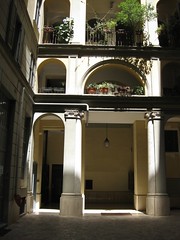
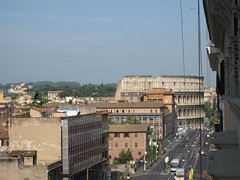
Apart from that I am ashamed to say no art galleries or exhibitions, and my main view of Rome has been the area between Termini station, the Department, and my appartment, ‘Al Colosseo’, a lovely location within sight (just) of the Collosseum (see below).

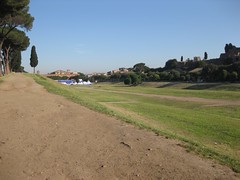
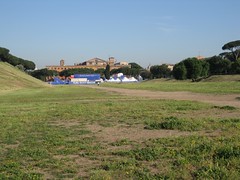
However, most mornings I have taken a run down past the Colloseum as far as Circo Massimo and one or more laps of that. It is a popular spot for morning runners, although I prefer it best when I get there a little earlier. Not to avoid the others, but because from about 7am when the sun starts to rise it gets so hot. The most interesting end of Circo Massimo is currently boarded off as they do works there and in the last 2 weeks the far end has turned into a mini-stadium for Beach Soccer, I assume to coincide with the UEFA football next week.

Tonight it will be another pizza evening and I am promised it will be at a place that specialises in Roman-style pizzas and those lovely deep fried vegetables. Italy is about sun and ruins, about design and expensive cars and the Vatican and bureaucracy, … but above all it is about food and friends.

September 18, 2008

Comics and happy problem solving

Filed under: HCI and usability, academic, books, web development — alan @ 3:39 pm

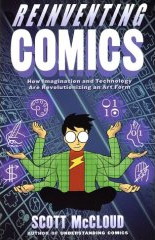
I am in Eindhoven doing CSCW, silly ideas and other things with the USI students here. On the book shelf here is Scott McCloud’s “Understanding Comics” I picked this up last year and couldn’t put it down until I had read it all. There is another book on the shelves this year “Reinventing Comics” and I daren’t pick it up until I’ve done all the work I want to today!

Understanding Comics is both an apologetic for comics as an art form and also an exploration into what makes a comic a comic and how comics manage to captivate and give a sense of narrative and action through what are basically static images. As well as being a good read about comics and about art there seem to be many lessons there for other forms of narrative and animation especially on the web.

As far as I can see (without starting to read it and not being able to stop), Reinventing Comics seems to be about the way online delivery trough the web is giving new opportunities for Comic art … but maybe when I finish everything today I will find out.

Less graphic and less fun, but no less fascinating, I have been dipping into chapters of “The Psychology of Problem Solving“, which was also sitting on the USI shelves. I was particularly enthralled by descriptions of experiments where subjects were asked to accomplish divergent thinking tasks whilst either pushing their palms upwards from under a table, or pushing down from on top. The former a positive, ‘come to me’ gesture elicited more diverse ideas than the latter, negative, ‘go away’ gesture, even though the only difference was the muscle groups in tension. I’ve seen other research that shows how our brains monitor our body state to ’see how we feel’ (like smiling therapy), but this was one of the most subtle and conclusive.

During the week I have had the USI students work through a design brief starting with silly ideas then moving through  structured analysis to good ideas. Perhaps I should have had them pushing up on tables in the first part and down in the second?

May 8, 2008

pantoum amongst the lost emails

Filed under: books, personal — alan @ 6:42 am

About to go off to Edinburgh for 2 day meeting of the Branded Meeting Places project in

Doing quick check on my outbox for 1/2 written emails that I need to finish … and then found the following from July 2006

spring flowers in the meadow
gold sunshine glinting
the grass between lies
cool and smooth

gold sunshine glinting
across the rippling waters
cool and smooth
towards the lonely isle

across the rippling waters
birds fly gently
towards the lonely isle
majestic but desolate

birds fly gently
spring long past
majestic but desolate
the snow buried grass

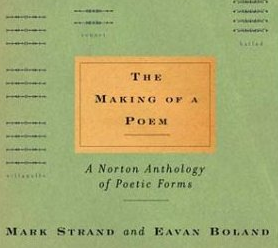
The Making of a PoemI recall the context now. I has been reading “The Making of a Poem” a lovely book, that discusses different poetic forms both history and current use and with loads of examples of each, classic and modern. I was talking to Masitah about the pantoum, a Malay poetic form where the 2nd and 4th line of each verse become the 1st and 3rd line of the next verse. I constructed the above as an example as we chatted! I had typed it into an email to save it and there it has lain, forgotten, ever since.

I think traditional pantoums have a particular rhythm structure within each verse, so my attempt above has the right line structure structure, but not the right metre. However, I did like the way it created an apparent continuity, yet the meaning could shift underneath – in this case from spring to winter.

My favourite in the book was a modern pantoum by J. M. McClatchy. He repeats the sound of the lines … but not necessarily the words … so in the first verse, the second line is “Seem to pee more often, eat” and in the beginning of the second verse this becomes “Sympathy, more often than not“. Or in the middle “The hearth’s easy, embered expense” becomes “The heart’s lazy: remembrance spent“.

Now back to looking for those urgent mails before the train!

May 3, 2008

when virtual becomes real

Filed under: Uncategorized, academic — alan @ 9:48 am

Just read Adam Greenfield’s blog entry “Reality bites“. He describes how a design he produced for a friend’s new restaurant became a solid metal sign within days. Despite knowing about recent rapid fabrication techniques, actually seeing these processes in action for his own design was still shocking.

I too am still amazed at the relative ease that ideas can be turned into reality. In a presentation “As we may print” at the 2003 Interaction Design for Children, Michael Eisenberg described how he and his co-workers at University Colorado were using laser cutters to enable children to design their own 3D designs in card or even thin plywood. More recently at the National Centre for Product Design and Development Research in Cardiff, I saw 3D metal printers. I was aware of 3D printers working in various gels and foams, but did not realise it was possible to create parts in titanium and steel, simply printed from 3D CAD designs. Chasing one of Adam’s links I found instructions to make your own 3D printer on the MIT site … however, this constructs your designs in pasta paste not metal!

One of the arguments we are making about our FireFly technology is that it will change lighting from being a matter of engineering and electronics, to a digital medium where the focus moves form hardware to software. While FireFly allows more flexible 2D and 3D arrangements than other technologies we are aware of, it is certainly not alone in making this transformation in lighting. Last week I was talking to Art Lights London and they are planning some large installations using Barco’s LED lighting arrays. Soon anything that you can point on your computer screen you will also be able to paint in light from your own Christmas tree to London Bridge.

Although it sometimes seems that technology is simply fuelling war and environmental catastrophe, it is a joy to still glimpse these occasional moments of magic.

January 26, 2008

mirrors and estrangement

Filed under: HCI and usability, academic, books — alan @ 1:07 pm

One of my PhD students, Fariza, has been extensively studying a single person, a women not so disimilar from herself. In doing so they have become friends and much of Fariza’s thesis (soon to be submitted) concerns the methodological issues surrounding this.

pianoOne issue we have discussed at length is the importance of estrangement, that distancing oneself from the commonplace to make the taken for granted become apparent. We do not see the things closest to us: the dirty toenail, the crumpled sheet, the asymmetric fall of the piano music stand, the things lost because they are in the open.

Artists and comedians often open our eyes to the unseen-because-unnoticed aspects of life, such as Emin’s own crumpled sheets or the poignant woman on the platform in “The Fall and Rise of Reggie Perrin”1. Garfinkel’s breaching experiments attempt to bring this incisive comic eye to social science. Of novelists Gabriel Garcí­a Márquez is the master of this; through his true to life yet surreal accounts, with sometimes tenderness and sometimes almost cruel dispassion, he describes in intricate detail the intimate yet insignificant.

The Last Battle, C.S. LewisBerger talks about the way artists look at their work in a mirror to see it afresh and he himself sees the sunshine of lilacs in the mirror, lilacs that show him only their shadows2. I was reminded of one of C.S. Lewis’ Narnia books where the supra-reality of the mirror image is more crystal sharp, more ‘real’ than the ordinary world3.

Mirrors bring to mind reflective practice, just as Fariza has to write herself into her own accounts, the mirror often shows not only the unseen side of an object but also oneself and oneself in relation to the object. The seer and seen are themselves seen and, like Berger’s lilacs, the partiality of one’s seeing becomes more obvious. The mirror is not so much important because it shows the hidden sun-glowed lilacs, but because it says that the shadowed petals are not the whole flower.

Arnolfini Mariage: mirror closeupI am reminded of that Dutch painting by van Eyck where the apparently pregnant woman and her husband stand in their home with their lap dog between them and discarded outdoor shoes untidily dropped4. On the wall behind the couple is a convex mirror capturing the whole scene from behind, and in the reflected doorway where you stand is the tiny image of van Eyck and another. Unlike supposedly ‘good’ scientific writing in incomprehensible passive speech, the artist has not painted himself out of his picture.

Arnolfini Mariage: dog closeupBerger also talks about paintings being painted for the moment of seeing, yet so many portraits do not look towards you, or even the artist, but through you, beyond you, to an unseen landscape. This may be because it is hard to paint eyes, or because it is hard to stare into the eyes of one’s painter. In life it is only with the deepest lovers or friends that we dare to share like this, hence perhaps the growing friendship that Fariza experienced when gazing deeply together into her subject’s life. Also, perhaps why the most intimate paintings have often been of the painter’s wives or lovers. Unusually in van Eyck’s painting, clearly of close friends, the couple do not gaze either aloof or uncaring past the viewer, but instead gaze within the painting demurely to one another … it is only the small dog that stares back.

Mona LisaThis may be part of the Mona Lisa’s allure. I have never seen it ‘in the flesh’, but everyone talks about the eyes that they follow you. However, look again, it is not so much that they follow you, but, unusual amongst paintings, they actually look at you and I suppose at Leonardo himself.

I know Fariza has found this, and I am sure it is universal, that if we look closely and honestly at those around us, we begin more clearly to see ourselves .


  1. This was a popular BBC TV series, but it is the book which I remember as most moving, I laughed out loud and shed tears equally. [back]
  2. John Berger, “and our faces, my heart, brief as photos“, Bloomsbury, 2005 [back]
  3. end of Chapter 15 in “The Last Battle“ [back]
  4. The page about the Arnolfini Portrait at the National Gallery site allows you to zoom into the image. It also explains that the woman is not actually pregnant, but simply in the full skirt style of the day. [back]

May 13, 2007

digital culture

Filed under: academic — alan @ 8:58 am

I was at futuresonic last Friday doing a panel keynote at the Social Technologies Summit. I talked about various things connected to imagination: bad ideas, regret modelling and firefly/fairylights technology. On the same panel was a guy from Satchi and Satchi who created television adds for T-mobile and a lady from Goldsmiths who described a project for Intel where they studied a London bus route. The chair Eric introduced the session with a little about blogging and other web-based technologies and in general we were immersed in the ways in which digital culture pervades the day to day world.
In my way home on the train I sat opposite a father and son who were playing hangman. The boy was about 6 or 7 and the father had to help him and sometimes correct him. Every so often I noticed the words they chose, but just before I got off the train there was obviously the father’s hardest challenge yet. I gradually noticed the hightened excitement in the voices … it was a word with ‘X’ and ‘Y’ in it.

As I stood to get up, the boy eventually got the last letters and completed the word …

F O X Y B I N G O . C O M

Powered by WordPress